We are currently upgrading our shopping cart; in the interim all orders are being diverted to Waterstones. If you would like to redeem a promotional code, or are an author wanting to place an order, please email us.

Contact us

The Correspondence of Jeremy Bentham, Volume 14

This volume, which supplements the main chronological series of The Correspondence of Jeremy Bentham, contains 252 letters written to and from Jeremy Bentham, 19 letters written to and from individuals other than Bentham but containing material of biographical interest, and the will made by Bentham on 17 August 1785. The letters have either never before been published or been only partially published in previous volumes of The Correspondence. A large number of the letters were written by Bentham’s brother Samuel on his journey to Russia and during his sojourn in Russia, covering the years 1779 to 1791. This meticulously researched and richly annotated volume contains much new information of biographical interest and deepens our knowledge of Bentham’s relationship with his family, with the panopticon penitentiary scheme, and with such ‘disciples’ as Étienne Dumont, Henry Bickersteth, and Leicester Stanhope. Of particular interest will be correspondence with Prince Grigory Alexandrovich Potemkin, Sir Samuel Romilly, Jacques Pierre Brissot de Warville, and John Quincy Adams.
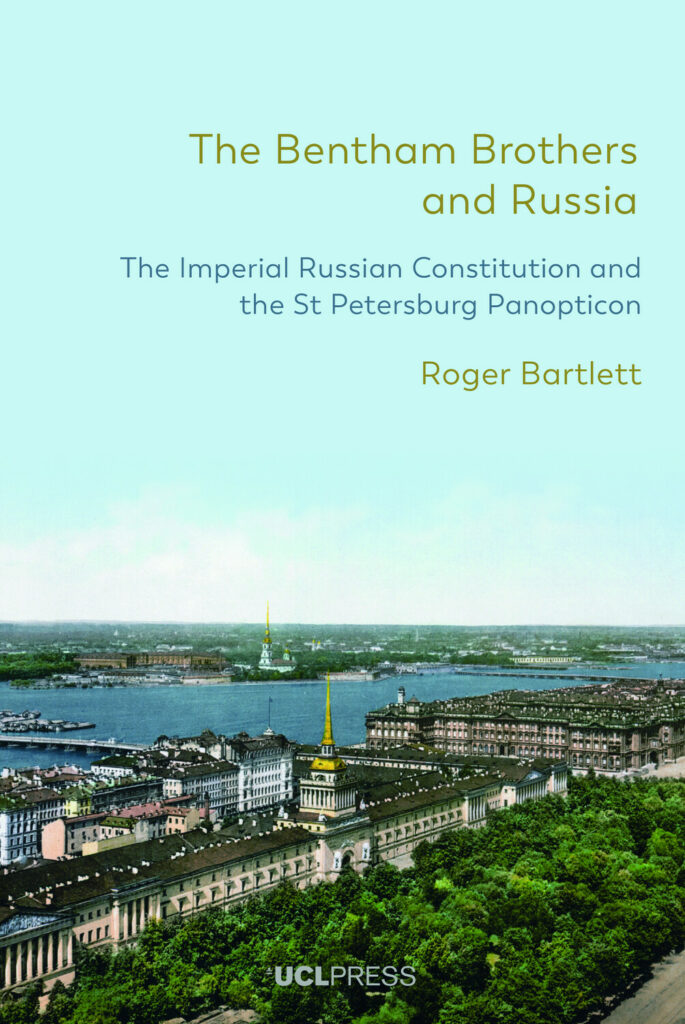
The Bentham Brothers and Russia

The jurist and philosopher, Jeremy Bentham, and his lesser-known brother, Samuel, equally talented but as a naval architect, engineer and inventor, had a long love affair with Russia. Jeremy hoped to assist Empress Catherine II with her legislative projects. Samuel went to St Petersburg to seek his fortune in 1780 and came back with the rank of Brigadier-General and the idea, famously publicised by Jeremy, of the Inspection-House or Panopticon. The Bentham Brothers and Russia chronicles the brothers’ later involvement with the Russian Empire, when Jeremy focused his legislative hopes on Catherine’s grandson Emperor Alexander I (ruled 1801-25) and Samuel found a unique opportunity in 1806 to build a Panopticon in St Petersburg – the only panoptical building ever built by the Benthams themselves.

Setting the Benthams’ projects within an in-depth portrayal of the Russian context, Roger Bartlett illuminates an important facet of their later careers and offers insight into their world view and way of thought. He also contributes towards the history of legal codification in Russia, which reached a significant peak in 1830, and towards the demythologising of the Panopticon, made notorious by Michel Foucault: the St Petersburg building, still relatively unknown, is described here in detail on the basis of archival sources. The Benthams’ interactions with Russia under Alexander I constituted a remarkable episode in Anglo-Russian relations; this book fills a significant gap in their history.

Sign up to our newsletter

Don't miss out!
Subscribe to the UCL Press newsletter for the latest open access books,
journal CfPs, news and views from our authors and much more!