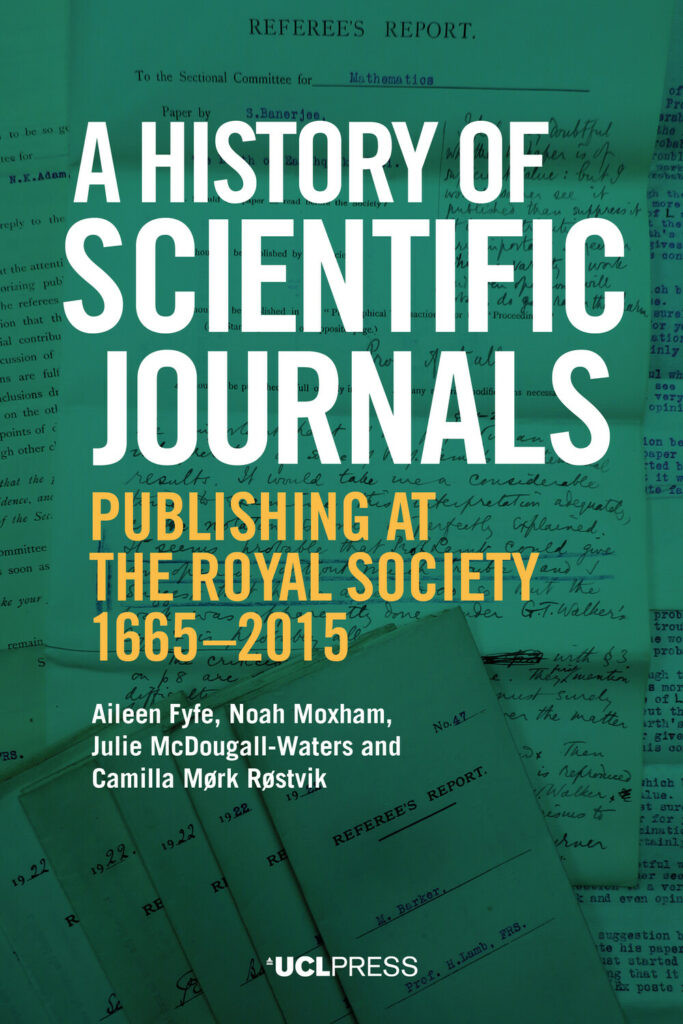
A History of Scientific Journals

Modern scientific research has changed so much since Isaac Newton’s day: it is more professional, collaborative and international, with more complicated equipment and a more diverse community of researchers. Yet the use of scientific journals to report, share and store results is a thread that runs through the history of science from Newton’s day to ours. Scientific journals are now central to academic research and careers. Their editorial and peer-review processes act as a check on new claims and findings, and researchers build their careers on the list of journal articles they have published. The journal that reported Newton’s optical experiments still exists. First published in 1665, and now fully digital, the Philosophical Transactions has carried papers by Charles Darwin, Dorothy Hodgkin and Stephen Hawking. It is now one of eleven journals published by the Royal Society of London.

Unrivalled insights from the Royal Society’s comprehensive archives have enabled the authors to investigate more than 350 years of scientific journal publishing. The editorial management, business practices and financial difficulties of the Philosophical Transactions and its sibling Proceedings reveal the meaning and purpose of journals in a changing scientific community. At a time when we are surrounded by calls to reform the academic publishing system, it has never been more urgent that we understand its history.

Women in the History of Science

Women in the History of Science brings together primary sources that highlight women’s involvement in scientific knowledge production around the world. Drawing on texts, images and objects, each primary source is accompanied by an explanatory text, questions to prompt discussion, and a bibliography to aid further research. Arranged by time period, covering 1200 BCE to the twenty-first century, and across 12 inclusive and far-reaching themes, this book is an invaluable companion to students and lecturers alike in exploring women’s history in the fields of science, technology, mathematics, medicine and culture.

While women are too often excluded from traditional narratives of the history of science, this book centres on the voices and experiences of women across a range of domains of knowledge. By questioning our understanding of what science is, where it happens, and who produces scientific knowledge, this book is an aid to liberating the curriculum within schools and universities.

War Essays

Cover of the book War Essays by Zainab Bahrani, published by UCL Press. The cover features an abstract, burnt and weathered parchment design with fragments of red and black imagery.

More than 20 years have passed since Iraq was invaded in an illegal war, justified on the basis of falsified evidence. Operation Iraqi Freedom led to untold human suffering and massive destruction, the ruinous consequences of which persist to this very day. The war and occupation also had a devastating impact on the history and heritage of Iraq, a land ironically seen as the cradle of civilisation. The scale of theft and destruction of heritage sent shockwaves around the world that had radical consequences for the trade in antiquities and museum practices across the globe, and contributed to a paradigm shift in the discipline of archaeology.

In War Essays Zainab Bahrani charts the devastation, cultural cleansing and targeted erasure of Iraq’s past, and argues that the topics of archaeology, history and memory must be analysed within the larger geopolitical issues of the contemporary Middle East. The essays present a counter-narrative of events that historicize the position of the historian and illustrate the enduring colonial practices of archaeology. Set within a narrative that reflects at once upon the violence of war and the processes of writing, an archaeologist’s personal journey unfolds. War Essays intertwines the autobiographical with the historical and analytical aspects of scholarship, weaving an eye-witness account of war with theoretical discussions around writing, the relationship of monuments, historical landscapes and memory, and how one’s sense of place in the world is disrupted by war.

Sign up to our newsletter

Don't miss out!
Subscribe to the UCL Press newsletter for the latest open access books,
journal CfPs, news and views from our authors and much more!