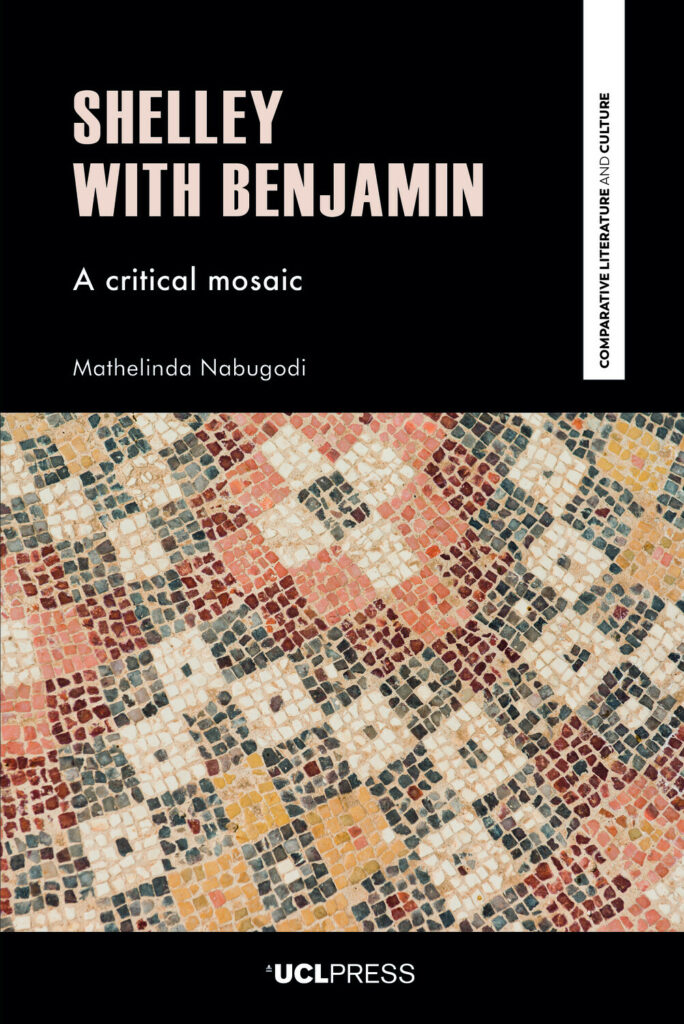
Shelley with Benjamin

*Yet what surprises me most of all at this time is that what I have written consists, as it were, almost entirely of quotations. – Compositions so produced are to poetry what mosaic is to painting. – It is the craziest mosaic technique you can imagine – and the very mind which directs the hands in formation is incapable of accounting to itself for the origin, the gradations, or the media of the process.

Shelley with Benjamin: A critical mosaic is an experiment in comparative reading. Born a century apart, Percy Bysshe Shelley and Walter Benjamin are separated by time, language, temperament and genre – one a Romantic poet known for his revolutionary politics and delicate lyricism, the other a melancholy intellectual who pioneered a dialectical method of thinking in constellations. Yet, as the above montage of citations from their works demonstrates, their ideas are mutually illuminating: the mosaic is but one of several images that both use to describe how literature lives on through practices of citation, translation and critical commentary.

In a series of close readings that are by turns playful, erotic and violent, Mathelinda Nabugodi unveils affinities between two writers whose works are simultaneously interventions in literary history and blueprints for an emancipated future. In addition to offering fresh interpretations of both major and minor writings, she elucidates the personal and ethical stakes of literary criticism. Throughout the book, marginal annotations and interlinear interruptions disrupt the faux-objective and colourblind stance of standard academic prose in an attempt to reckon with the barbarism of our past and its legacy in the present.

The book will appeal to readers of Shelley and Benjamin as well as those with an interest in comparative literature, literary theory, romantic poetics, and creative critical writing.
Mediating Vulnerability

Mediating Vulnerability examines vulnerability from a range of connected perspectives. It responds to the vulnerability of species, their extinction but also their transformation. This tension between extreme danger and creativity is played out in literary studies through the pressures the discipline brings to bear on its own categories, particularly those of genre. Extinction and preservation on the one hand, transformation, adaptation and (re)mediation on the other. These two poles inform our comparative and interdisciplinary project. The volume is situated within the particular intercultural and intermedial context of contemporary cultural representation. Vulnerability is explored as a site of potential destruction, human as well as animal, but also as a site of potential openness.

This is the first book to bring vulnerability studies into dialogue with media and genre studies. It is organised in four sections: ‘Human/Animal’; Violence/Resistance’; ‘Image/Narrative’; and ‘Medium/Genre’. Each chapter considers the intersection of vulnerability and genre from a comparative perspective, bringing together a team of international contributors and editors. The book is in dialogue with the reflections of Judith Butler and others on vulnerability, and it questions categories of genre through an interdisciplinary engagement with different representational forms, including digital culture, graphic novels, video games, photography and TV series, in addition to novels and short stories. It offers new readings of high-profile contemporary authors of fiction including Margaret Atwood and Cormac McCarthy, as well as bringing lesser-known figures to the fore.

Sign up to our newsletter

Don't miss out!
Subscribe to the UCL Press newsletter for the latest open access books,
journal CfPs, news and views from our authors and much more!