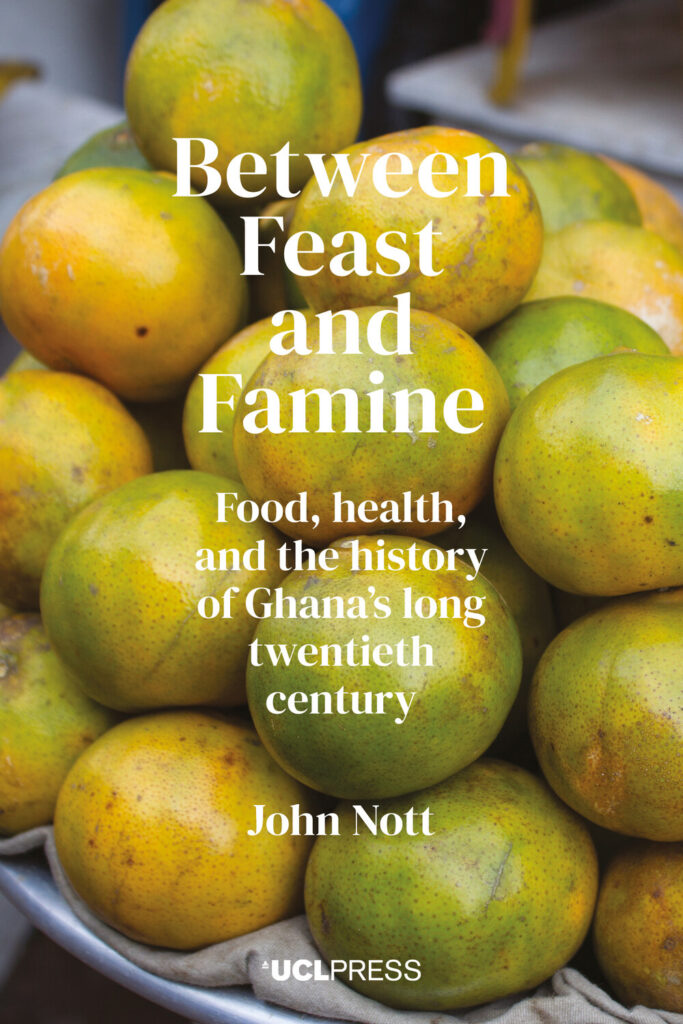
Between Feast and Famine

Shortlisted for the RHS First Book Prize 2026

Ghana’s twentieth century was one of dramatic political, economic, and environmental change. Sparked initially by the impositions of colonial rule, these transformations had significant, if rarely uniform, repercussions for the determinants of good and bad nutrition. All across this new and uneven polity, food production, domestic reproduction, gender relations, and food cultures underwent radical and rapid change. This volatile national history was matched only by the scientific instability of nutritional medicine during these same years.

Moving between the dry Northern savannah, the mineral-rich and food-secure Southern rainforest, and the youthful, ever-expanding cities, Between Feast and Famine is a comparative history of nutrition in Ghana since the end of the nineteenth century. At the heart of this story is an analysis of how an uneven capitalist transformation variously affected the lives of women and children. It traces the change from sporadic periods of hunger in the nineteenth and early twentieth centuries, through epidemics of childhood malnutrition during the twentieth century, and into emergent epidemics of diet-related non-communicable disease in the twenty-first century. Employing a novel, critical approach to historical epidemiology, John Nott argues that detailing the co-production of science and its subjects in the past is essential for understanding and improving health in the present.

Biosocial Worlds

Biosocial Worlds presents state-of-the-art contributions to anthropological reflections on the porous boundaries between human and non-human life – biosocial worlds. Based on changing understandings of biology and the social, it explores what it means to be human in these worlds. Growing separation of scientific disciplines for more than a century has maintained a separation of the ‘natural’ and the ‘social’ that has created a space for projections between the two. Such projections carry a directional causality and so constitute powerful means to establish discursive authority.

While arguing against the separation of the biological and the social in the study of human and non-human life, it remains important to unfold the consequences of their discursive separation. Based on examples from Botswana, Denmark, Mexico, the Netherlands, Uganda, the UK and USA, the volume explores what has been created in the space between ‘the social’ and ‘the natural’, with a view to rethink ‘the biosocial’. Health topics in the book include diabetes, trauma, cancer, HIV, tuberculosis, prevention of neonatal disease and wider issues of epigenetics. Many of the chapters engage with constructions of health and disease in a wide range of environments, and engage with analysis of the concept of ‘environment’. Anthropological reflection and ethnographic case studies explore how ‘health’ and ‘environment’ are entangled in ways that move their relation beyond interdependence to one of inseparability. The subtitle of this volume captures these insights through the concept of ‘health environment’, seeking to move the engagement of anthropology and biology beyond deterministic projections.

Biosocial Worlds brings together state-of-the-art contributions to critical anthropological reflection on, and ethnographic exploration of, human and non-human life in the light of our changing understandings of biology and what it means to be human.

Sign up to our newsletter

Don't miss out!
Subscribe to the UCL Press newsletter for the latest open access books,
journal CfPs, news and views from our authors and much more!