We are currently upgrading our shopping cart; in the interim all orders are being diverted to Waterstones. If you would like to redeem a promotional code, or are an author wanting to place an order, please email us.

Contact us

Panopticon versus New South Wales and other writings on Australia

The present edition of Panopticon versus New South Wales and other writings on Australia consists of fragmentary comments headed ‘New Wales’, dating from 1791; a compilation of material sent to William Wilberforce in August 1802; three ‘Letters to Lord Pelham’ and ‘A Plea for the Constitution’, written in 1802–3; and ‘Colonization Company Proposal’, written in August 1831, the majority of which is published here for the first time. These writings, with the exception of ‘Colonization Company Proposal’, are intimately linked with Bentham’s panopticon penitentiary scheme, which he regarded as an immeasurably superior alternative to criminal transportation, the prison hulks, and English gaols in terms of its effectiveness in achieving the ends of punishment. He argued, moreover, that there was no adequate legal basis for the authority exercised by the Governor of New South Wales. In contrast to his opposition to New South Wales, Bentham later composed ‘Colonization Company Proposal’ in support of a scheme proposed by the National Colonization Society to establish a colony of free settlers in southern Australia. He advocated the ‘vicinity-maximizing principle’, whereby plots of land would be sold in an orderly fashion radiating from the main settlement, and suggested that, within a few years, the government of the colony should be transformed into a representative democracy.
The Correspondence of Jeremy Bentham, Volume 3

The first five volumes of the Correspondence of Jeremy Bentham contain over 1,300 letters written both to and from Bentham over a 50-year period, beginning in 1752 (aged three) with his earliest surviving letter to his grandmother, and ending in 1797 with correspondence concerning his attempts to set up a national scheme for the provision of poor relief. Against the background of the debates on the American Revolution of 1776 and the French Revolution of 1789, to which he made significant contributions, Bentham worked first on producing a complete penal code, which involved him in detailed explorations of fundamental legal ideas, and then on his panopticon prison scheme. Despite developing a host of original and ground-breaking ideas, contained in a mass of manuscripts, he published little during these years, and remained, at the close of this period, a relatively obscure individual. Nevertheless, these volumes reveal how the foundations were laid for the remarkable rise of Benthamite utilitarianism in the early nineteenth century.

The letters in this volume document Bentham’s meeting and friendship with the Earl of Shelburne (later the Marquis of Lansdowne), which opened a whole new set of opportunities for him, as well as his extraordinary journey, by way of the Mediterranean, to visit his brother Samuel in Russia.

The Correspondence of Jeremy Bentham, Volume 5

The first five volumes of the Correspondence of Jeremy Bentham contain over 1,300 letters written both to and from Bentham over a 50-year period, beginning in 1752 (aged three) with his earliest surviving letter to his grandmother, and ending in 1797 with correspondence concerning his attempts to set up a national scheme for the provision of poor relief. Against the background of the debates on the American Revolution of 1776 and the French Revolution of 1789, to which he made significant contributions, Bentham worked first on producing a complete penal code, which involved him in detailed explorations of fundamental legal ideas, and then on his panopticon prison scheme. Despite developing a host of original and ground-breaking ideas, contained in a mass of manuscripts, he published little during these years, and remained, at the close of this period, a relatively obscure individual. Nevertheless, these volumes reveal how the foundations were laid for the remarkable rise of Benthamite utilitarianism in the early nineteenth century.

Bentham’s life in the mid-1790s was dominated by the panopticon, both as a prison and as a network of workhouses for the indigent. The letters in this volume document in excruciating detail Bentham’s attempt to build a panopticon prison in London, and the opposition he faced from local aristocratic landowners. His brother Samuel was appointed as Inspector-General of Naval Works and in September 1796 married Mary Sophia Fordyce.

The Correspondence of Jeremy Bentham, Volume 4

The first five volumes of the Correspondence of Jeremy Bentham contain over 1,300 letters written both to and from Bentham over a 50-year period, beginning in 1752 (aged three) with his earliest surviving letter to his grandmother, and ending in 1797 with correspondence concerning his attempts to set up a national scheme for the provision of poor relief. Against the background of the debates on the American Revolution of 1776 and the French Revolution of 1789, to which he made significant contributions, Bentham worked first on producing a complete penal code, which involved him in detailed explorations of fundamental legal ideas, and then on his panopticon prison scheme. Despite developing a host of original and ground-breaking ideas, contained in a mass of manuscripts, he published little during these years, and remained, at the close of this period, a relatively obscure individual. Nevertheless, these volumes reveal how the foundations were laid for the remarkable rise of Benthamite utilitarianism in the early nineteenth century.

In 1789 Bentham published An Introduction to the Principles of Morals and Legislation, which remains his most famous work, but which had little impact at the time, followed in 1791 by The Panopticon: or, The Inspection-House, in which he proposed the building of a circular penitentiary house. Bentham’s correspondence unfolds against the backdrop of the increasingly violent French Revolution, and shows his initial sympathy for France turning into hostility. On a personal level, in 1791 his brother Samuel returned from Russia, and in 1792 he inherited his father’s house in Queen’s Square Place, Westminster together with a significant property portfolio.

The Correspondence of Jeremy Bentham, Volume 2

The first five volumes of the Correspondence of Jeremy Bentham contain over 1,300 letters written both to and from Bentham over a 50-year period, beginning in 1752 (aged three) with his earliest surviving letter to his grandmother, and ending in 1797 with correspondence concerning his attempts to set up a national scheme for the provision of poor relief. The early letters deal with Bentham’s education at Oxford University, where he was sent at the age of 12 and graduated at the age of 16, and his legal training before being admitted to the bar at the age of 21. He soon afterwards turned his back on the practice of the law and, allying himself with the more radical and sceptical figures of the continental Enlightenment, embarked on a career of law reform.

Against the background of the debates on the American Revolution of 1776 and the French Revolution of 1789, to which he made significantcontributions, Bentham worked first on producing a complete penal code, and then on his panopticon prison scheme. Despite developing a host of original and ground-breaking ideas, contained in a mass of manuscripts, he published little during these years, and remained, at the close of this period, a relatively obscure individual. Nevertheless, these volumes reveal how the foundations were laid for the remarkable rise of Benthamite utilitarianism in the early nineteenth century.

Bentham’s educational ideas were the inspiration for the founding of UCL. The vast majority of Bentham’s papers, consisting of around 60,000 folios, are held in UCL Library.

Bentham’s correspondence reveals that in the late 1770s he was working intensively on the development of a code of penal law, but also expanding his acquaintance and, to a moderate degree, enhancing his reputation as a legal thinker. A significant family event took place in 1779, when his brother Samuel went to Russia in order to make his fortune.

The Correspondence of Jeremy Bentham, Volume 14

This volume, which supplements the main chronological series of The Correspondence of Jeremy Bentham, contains 252 letters written to and from Jeremy Bentham, 19 letters written to and from individuals other than Bentham but containing material of biographical interest, and the will made by Bentham on 17 August 1785. The letters have either never before been published or been only partially published in previous volumes of The Correspondence. A large number of the letters were written by Bentham’s brother Samuel on his journey to Russia and during his sojourn in Russia, covering the years 1779 to 1791. This meticulously researched and richly annotated volume contains much new information of biographical interest and deepens our knowledge of Bentham’s relationship with his family, with the panopticon penitentiary scheme, and with such ‘disciples’ as Étienne Dumont, Henry Bickersteth, and Leicester Stanhope. Of particular interest will be correspondence with Prince Grigory Alexandrovich Potemkin, Sir Samuel Romilly, Jacques Pierre Brissot de Warville, and John Quincy Adams.

The Correspondence of Jeremy Bentham, Volume 13

The Correspondence of Jeremy Bentham, Volume 13 contains authoritative and fully annotated texts of all known and publishable letters sent both to and from Bentham between 1 July 1828 and his death on 6 June 1832. In addition to 474 letters, the volume contains three memorandums concerning Bentham’s health shortly before his death, his Last Will and Testament, and extracts from both the Autobiography and the manuscript diaries of Bentham’s nephew George. Of the letters that have been previously published, most are drawn from the edition of The Works of Jeremy Bentham, prepared under the superintendence of Bentham’s literary executor John Bowring. A small number of letters have been reproduced from newspapers and periodicals.

This volume publishes for the first time all the extant correspondence between Bentham and Daniel O’Connell, the Irish Liberator. Other new acquaintances included Charles Sinclair Cullen, barrister and law reformer, and John Tyrrell, the Real Property Commissioner. Throughout the period, Bentham maintained regular contact with old friends and connections, but he also entered into sporadic correspondence with such leading figures in government as the Duke of Wellington, Robert Peel and Henry Brougham. Further afield, Bentham corresponded, amongst others, with the Marquis de La Fayette in France, Edward Livingston in the United States of America and José del Valle in Guatemala.

The Correspondence of Jeremy Bentham, Volume 1

The first five volumes of the Correspondence of Jeremy Bentham contain over 1,300 letters written both to and from Bentham over a 50-year period, beginning in 1752 (aged three) with his earliest surviving letter to his grandmother, and ending in 1797 with correspondence concerning his attempts to set up a national scheme for the provision of poor relief. Against the background of the debates on the American Revolution of 1776 and the French Revolution of 1789, to which he made significant contributions, Bentham worked first on producing a complete penal code, which involved him in detailed explorations of fundamental legal ideas, and then on his panopticon prison scheme. Despite developing a host of original and ground-breaking ideas, contained in a mass of manuscripts, he published little during these years, and remained, at the close of this period, a relatively obscure individual. Nevertheless, these volumes reveal how the foundations were laid for the remarkable rise of Benthamite utilitarianism in the early nineteenth century.

Bentham’s early life is marked by his extraordinary precociousness, but also family tragedy: by the age of 10 he had lost five infant siblings and his mother. The letters in this volume document his difficult relationship with his father and his increasing attachment to his surviving younger brother Samuel, his education, his interest in chemistry and botany, and his committing himself to a life of philosophy and legal reform.

Jeremy Bentham on Police

Jeremy Bentham’s ideas on punishment are famous. Every criminology student learns about Bentham, and every criminologist contends with him, as advocate or opponent. This discourse concerns his ideas about punishment, namely with respect to legislation and the panopticon. Yet, scholars and students are generally ignorant of Bentham’s ideas on police. Hitherto, these ideas have been largely unknowable. Now, thanks to UCL’s Bentham Project, these ideas are public.

Jeremy Bentham on Police celebrates this achievement by exploring the story of Bentham’s writings on police and considering their relevance to the past, present and future of criminology. After Scott Jacques introduces the book, the Director of the Bentham Project, Philip Schofield, describes and explains how it works. Then Michael Quinn, who brought together Bentham’s writings on police, delves into the personal and socio-historical background in which they were created. An extract follows, representing the most (criminologically-)relevant passages from Bentham’s police writings. Finally, a rich variety of scholars offer their thoughts on what those writings mean for criminology. These contributions come from Anthony A. Braga, Ronald Clarke, David J. Cox, Stephen Douglas, Stephen Engelmann, G. Geltner, Joel F. Harrington, Jonathan Jacobs, Paul Knepper, Gloria Laycock, Gary T. Marx, Daniel S. Nagin, Graeme R. Newman, Pat O’Malley, Eric L. Piza, Kim Rossmo, Lucia Summers and Dean Wilson.

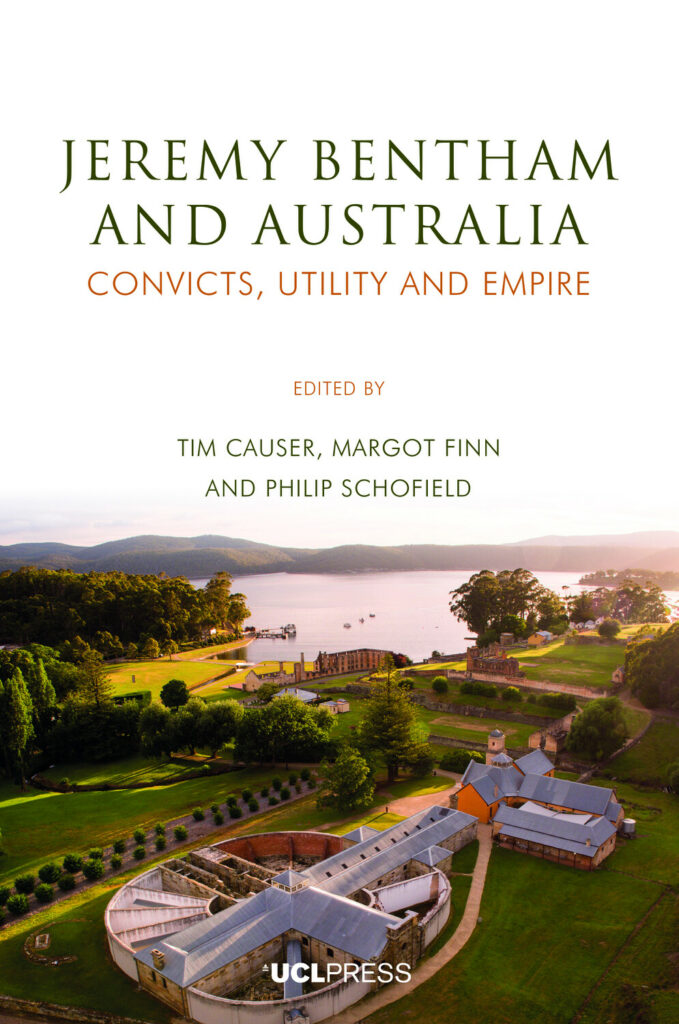
Jeremy Bentham and Australia

Jeremy Bentham and Australia is a collection of scholarship inspired by Bentham’s writings on Australia. These writings are available for the first time in authoritative form in Panopticon versus New South Wales and other writings on Australia, a volume in The Collected Works of Jeremy Bentham published by UCL Press.

In the present collection, a distinguished group of authors reflect on Bentham’s Australian writings, making original contributions to existing debates and setting agendas for future ones. In the first part of the collection, the works are placed in their historical contexts, while the second part provides a critical assessment of the historical accuracy and plausibility of Bentham’s arguments against transportation from the British Isles. In the third part, attention turns to Bentham’s claim that New South Wales had been illegally founded and to the imperial and colonial constitutional ramifications of that claim. Here, authors also discuss Bentham’s work of 1831 in which he supports the establishment of a free colony on the southern coast of Australia. In the final part, authors shed light on the history of Bentham’s panopticon penitentiary scheme, his views on the punishment and reform of criminals and what role, if any, religion had to play in that regard, and discuss apparently panopticon-inspired institutions built in the Australian colonies.

This collection will appeal to readers interested in Bentham’s life and thought, the history of transportation from the British Isles, and of British penal policy more generally, colonial and imperial history, Indigenous history, legal and constitutional history, and religious history.

Sign up to our newsletter

Don't miss out!
Subscribe to the UCL Press newsletter for the latest open access books,
journal CfPs, news and views from our authors and much more!