Panopticon versus New South Wales and other writings on Australia

The present edition of Panopticon versus New South Wales and other writings on Australia consists of fragmentary comments headed ‘New Wales’, dating from 1791; a compilation of material sent to William Wilberforce in August 1802; three ‘Letters to Lord Pelham’ and ‘A Plea for the Constitution’, written in 1802–3; and ‘Colonization Company Proposal’, written in August 1831, the majority of which is published here for the first time. These writings, with the exception of ‘Colonization Company Proposal’, are intimately linked with Bentham’s panopticon penitentiary scheme, which he regarded as an immeasurably superior alternative to criminal transportation, the prison hulks, and English gaols in terms of its effectiveness in achieving the ends of punishment. He argued, moreover, that there was no adequate legal basis for the authority exercised by the Governor of New South Wales. In contrast to his opposition to New South Wales, Bentham later composed ‘Colonization Company Proposal’ in support of a scheme proposed by the National Colonization Society to establish a colony of free settlers in southern Australia. He advocated the ‘vicinity-maximizing principle’, whereby plots of land would be sold in an orderly fashion radiating from the main settlement, and suggested that, within a few years, the government of the colony should be transformed into a representative democracy.
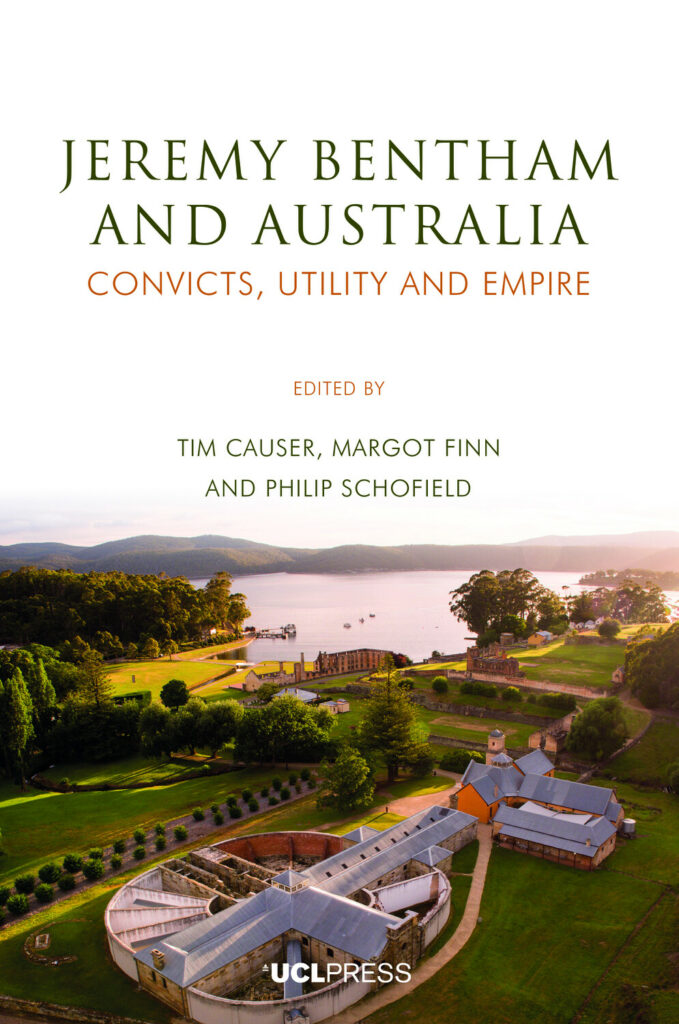
Jeremy Bentham and Australia

Jeremy Bentham and Australia is a collection of scholarship inspired by Bentham’s writings on Australia. These writings are available for the first time in authoritative form in Panopticon versus New South Wales and other writings on Australia, a volume in The Collected Works of Jeremy Bentham published by UCL Press.

In the present collection, a distinguished group of authors reflect on Bentham’s Australian writings, making original contributions to existing debates and setting agendas for future ones. In the first part of the collection, the works are placed in their historical contexts, while the second part provides a critical assessment of the historical accuracy and plausibility of Bentham’s arguments against transportation from the British Isles. In the third part, attention turns to Bentham’s claim that New South Wales had been illegally founded and to the imperial and colonial constitutional ramifications of that claim. Here, authors also discuss Bentham’s work of 1831 in which he supports the establishment of a free colony on the southern coast of Australia. In the final part, authors shed light on the history of Bentham’s panopticon penitentiary scheme, his views on the punishment and reform of criminals and what role, if any, religion had to play in that regard, and discuss apparently panopticon-inspired institutions built in the Australian colonies.

This collection will appeal to readers interested in Bentham’s life and thought, the history of transportation from the British Isles, and of British penal policy more generally, colonial and imperial history, Indigenous history, legal and constitutional history, and religious history.

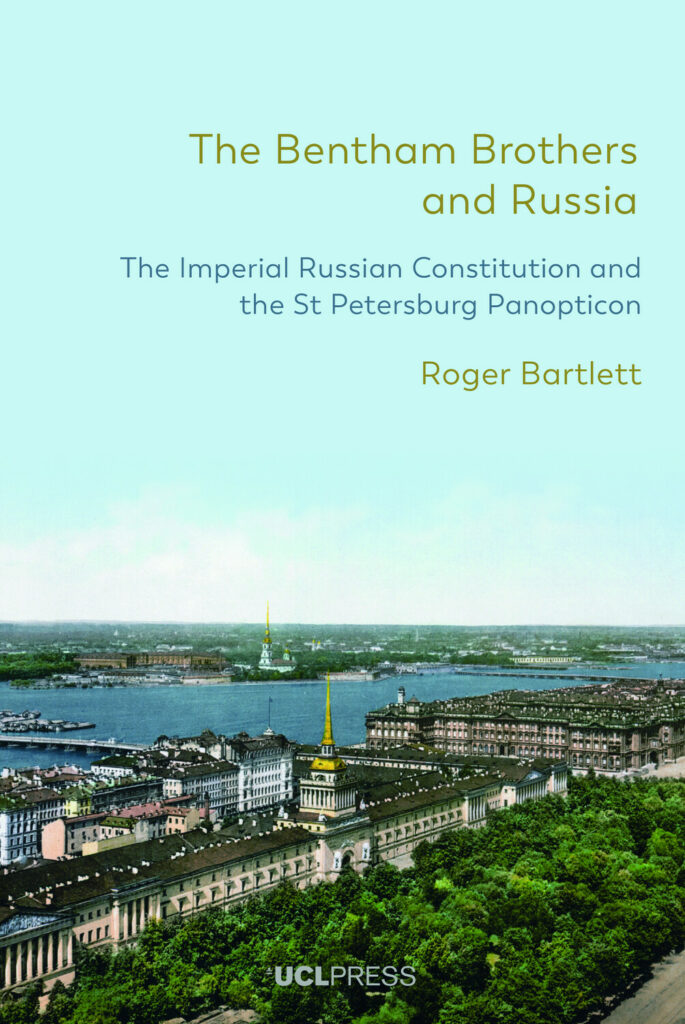
The Bentham Brothers and Russia

The jurist and philosopher, Jeremy Bentham, and his lesser-known brother, Samuel, equally talented but as a naval architect, engineer and inventor, had a long love affair with Russia. Jeremy hoped to assist Empress Catherine II with her legislative projects. Samuel went to St Petersburg to seek his fortune in 1780 and came back with the rank of Brigadier-General and the idea, famously publicised by Jeremy, of the Inspection-House or Panopticon. The Bentham Brothers and Russia chronicles the brothers’ later involvement with the Russian Empire, when Jeremy focused his legislative hopes on Catherine’s grandson Emperor Alexander I (ruled 1801-25) and Samuel found a unique opportunity in 1806 to build a Panopticon in St Petersburg – the only panoptical building ever built by the Benthams themselves.

Setting the Benthams’ projects within an in-depth portrayal of the Russian context, Roger Bartlett illuminates an important facet of their later careers and offers insight into their world view and way of thought. He also contributes towards the history of legal codification in Russia, which reached a significant peak in 1830, and towards the demythologising of the Panopticon, made notorious by Michel Foucault: the St Petersburg building, still relatively unknown, is described here in detail on the basis of archival sources. The Benthams’ interactions with Russia under Alexander I constituted a remarkable episode in Anglo-Russian relations; this book fills a significant gap in their history.

Sign up to our newsletter

Don't miss out!
Subscribe to the UCL Press newsletter for the latest open access books,
journal CfPs, news and views from our authors and much more!