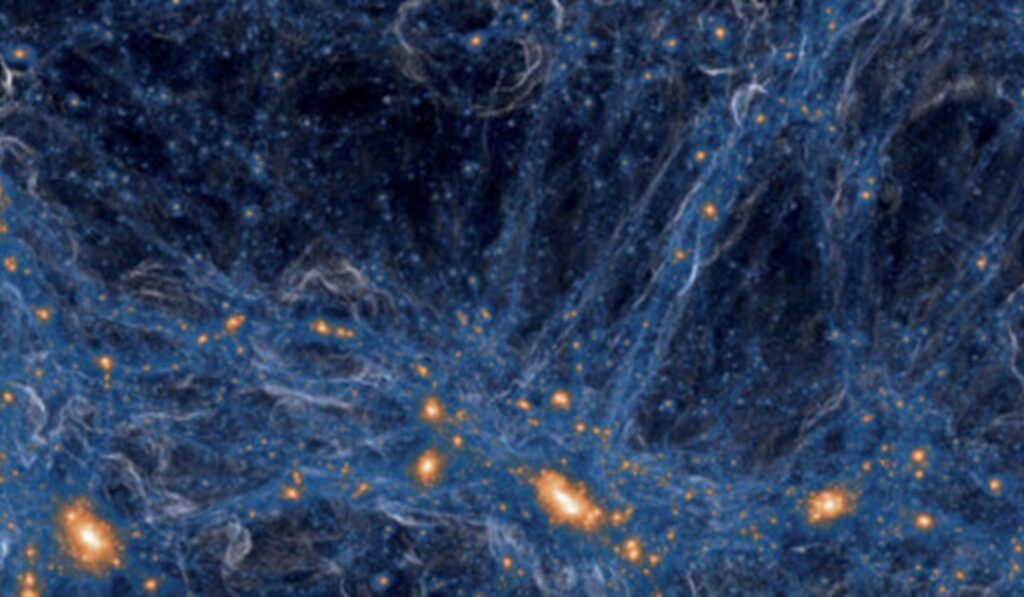
Today marks the publication of the open access textbook Fundamentals of Dark Matter by Ignacio Ferreras. This new book focuses on pedagogy that guides students through the facts regarding dark matter, and also encourages questions and critical examination of what is known to date.
In this blog post, Professor Ferreras provides an introduction to the discovery of dark matter and offers some pointers about how dark matter science may develop in future years.
Dark matter is unquestionably one of the most important topics of modern physics. Postulated nearly a century ago to account for the motion of galaxies in clusters, and then to describe the orbits of stars within galaxies, it is now found to pervade the Universe as the dominant component of all matter. In contrast, the “standard stuff”, i.e. matter put together by elements taken from the Periodic Table, amounts to a fraction roughly 16% by mass. The composition of dark matter is thus far unknown, but “ordinary particles” that make up the Standard Model are positively ruled out; even standard neutrinos cannot contribute more than a fraction of the total dark matter budget. The subject of dark matter thus overlaps a wide range of disciplines in astrophysics, cosmology and particle physics. Its elusive detection, along with its important contribution to the Universal mass content nicely exemplifies how science has to deal with such elephants in the room. While critics raise this issue to illustrate the weakness of science, it should be noted that there are numerous examples in the history of science when such situations were faced, and so it represents the strength, rather than the weakness, of the scientific method.
A not too dissimilar example of a gravitational conundrum can be found in our Solar system. The traditional family of five planets* (from Mercury to Saturn) has been known for millennia, due to their visibility to the naked eye and their wandering motion on the celestial sphere. Positional astronomy allowed us to make one of the most fundamental discoveries of humanity, namely the workings of the Solar environment through gravity, and the true nature of Earth as just another planet orbiting the Sun. Astrophysics adds one more step in this understanding of the Universe, by adopting a powerful methodology that compares precise measurements of the Heavens with a mathematically-based model (in this case the inverse square law of gravitational forces). After the discovery of planet Uranus by Sir William Herschel, following a careful investigation of a would-be comet by him and others (Lexell and Bode), astronomers were puzzled with the observations of the orbital motion of Uranus that could not be fully explained by the adopted paradigm of Newtonian gravity. In the nineteenth century, Adams and Le Verrier hypothesised a new planet (Neptune) to explain the observations, that was eventually discovered in 1846. In the decades spanning from the confirmation of Uranus as a major planet to the discovery of Neptune, we could make the case that “dark matter” was present in our Solar system.
On the other side of our planetary system, closer to the Sun, another example illustrates a new approach to tackle a similar problem. It was again Le Verrier, who proposed an additional, inner planet to explain the motion of Mercury. The orbit of Mercury was found to feature a characteristic precession of its perihelion, something that could not be accounted by Newton’s gravity. The search for the new “dark matter” was on, and spurious sightings of planet Vulcan were reported. This time, the true nature of Mercury’s motion was due to a substantial change in the adopted paradigm. Einstein’s theory of general relativity predicted a post-Newtonian perturbation in the inner parts of the Solar system that can fully accommodate Mercury’s orbital precession.
These two discoveries show how difficult it is to find definitive solutions to complex problems, and how the unexpected motion of a system can lead either to a new component (say, the dark matter particle), or a change in the working paradigm (say, our understanding of gravity).
My new textbook Fundamentals of Dark Matter, published by UCL Press, is meant to give advanced undergraduates and keen aficionados a general overview of this most elusive case of unexpected gravitational effects over scales ranging from galaxies to the whole Universe. Amazingly enough, the solution to the Dark Matter problem should come at the level of microphysics, in the form of a new particle and/or the modification of our incomplete paradigm based on the Standard Model of particle physics along with General Relativity.
* Plus our own Earth, of course.
About the Author
Ignacio Ferreras is a staff astronomer at the Instituto de Astrofisica de Canarias, in Tenerife, Spain and holds an honorary professor position at the Physics and Astronomy department, UCL. He was academic staff at the Mullard Space Science Laboratory, UCL for eleven years. After obtaining university degrees in theoretical physics in Valladolid, Spain, and Cornell University, USA, he embarked on a career in astrophysics with a PhD in Cantabria, Spain, followed by various research and academic appointments at Oxford, ETH Zürich, UCL, and King’s College London. He was a ‘La Caixa’ fellow and an individual Marie Curie fellow.