
Publication date: 11 May 2026
DOI: https://doi.org/10.14324/111.9781806550029
Number of illustrations: 73

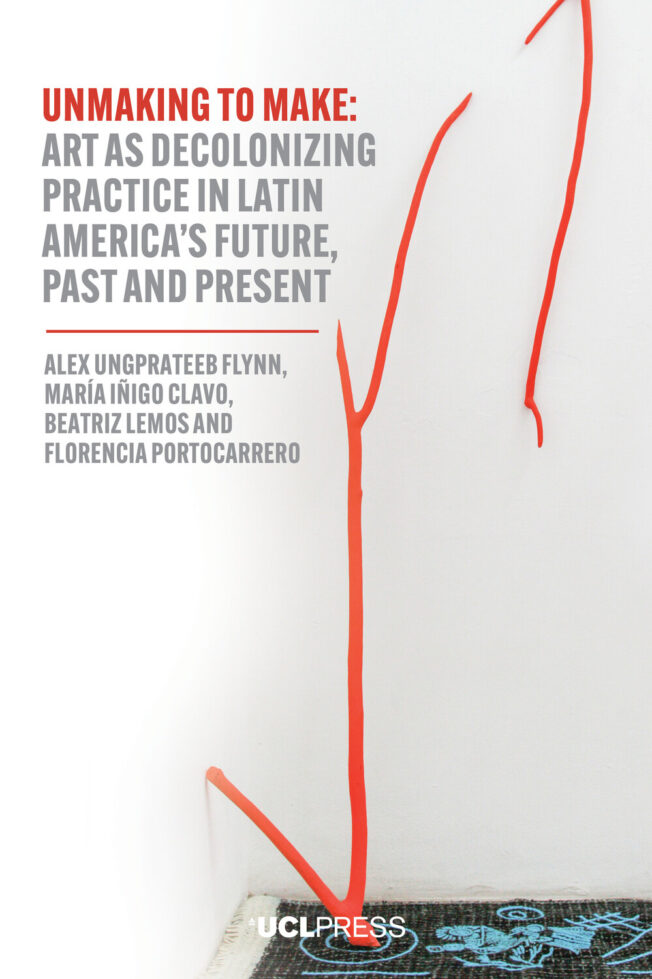
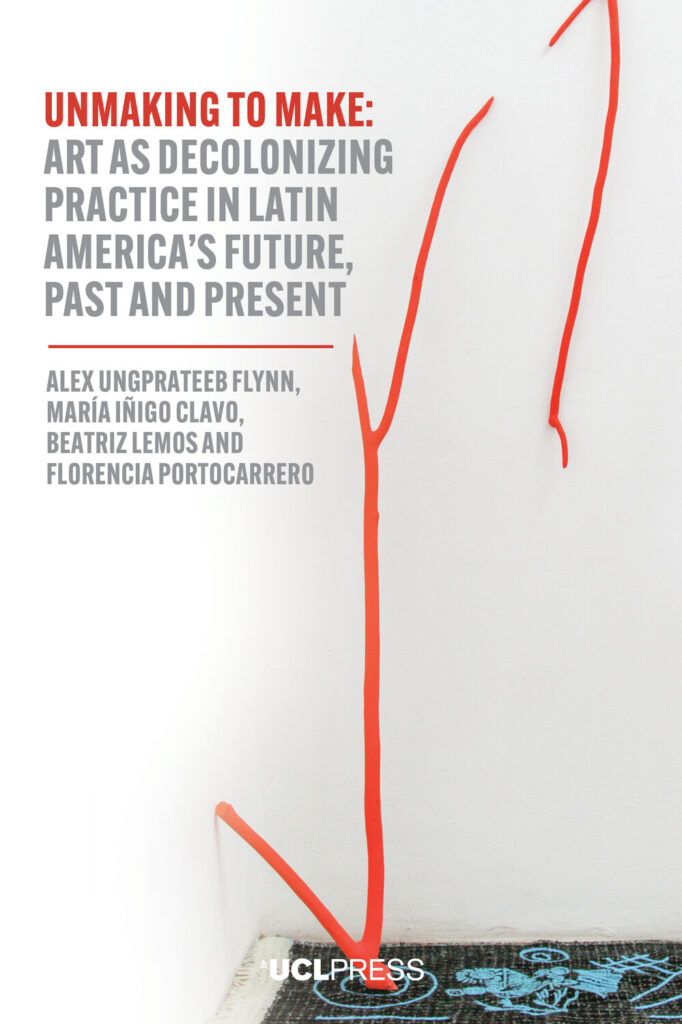
Unmaking to Make
Art as decolonising practice in Latin America’s future, past and present
Alex Ungprateeb Flynn (Editor), María Iñigo Clavo (Editor), Beatriz Lemos (Editor), Florencia Portocarrero (Editor)
Series: Modern Americas
The call to decolonise has become one of the dominant forces in contemporary art — yet its most radical possibilities are routinely absorbed and neutralised by the institutions of the Global North. Unmaking to Make intervenes in this impasse by turning to Latin America, centring Afro-diasporic and Indigenous perspectives from a region where artistic practice operates at the intersection of aesthetics, politics and social life, and whose thinkers and practitioners have long theorised decolonisation from within.
Drawing on essays, curatorial reflections and conversations with contributors from Argentina, Bolivia, Brazil, Chile, Cuba, Ecuador, Guatemala, Martinique, Mexico and Peru, the volume moves across four thematic terrains — counter-genealogies, museums and cultural institutions, the decolonisation of language, and plural temporalities – to show how art unsettles colonial narratives, reshapes knowledge and generates new vocabularies of power.
At its core, the volume makes a bold claim: that Latin American artistic practice is not just transforming the canon but articulating a form of thought – one that theorises, enacts and insists upon other worlds. Essential reading for scholars, curators, artists and students of contemporary art, decolonial thought and Latin American cultural politics.
List of figures
List of contributors
Introduction: Artistic practice and the unmaking of coloniality
Alex Ungprateeb Flynn, María Iñigo Clavo, Beatriz Lemos and Florencia Portocarrero
Part I: Counter-genealogies
1 Counter-histories, ‘Maya hackers’ and everyday life resistances
María Jacinta Xón Riquiac
2 Crossroads of popular arts: cultural resistance, artisanal practices and the racialisation of developmentalism in Ecuador
María Elena Bedoya Hidalgo and Pamela Cevallos Salazar
3 From decentralised mestizajes in Peru to mestizo masks in the Spanish pavilion: some genealogical routes of the decolonial in Latin American art
Sandra Gamarra Heshiki, María Iñigo Clavo and Agustín Pérez Rubio in conversation
4 Tracing the encontronazo, a Ladino genealogy of Afro-diasporic female art through Leliá González’s Amefricanidade
Karo Moret Miranda
Part II: Institutions amidst colonial legacies
5 Reconsidering the ‘art museum’: some reflections on the history of the MALI collections
Ricardo Kusunoki and Sharon Lerner
6 Community of praxis: integrating Indigenous knowledge in the management of the Museo Nacional de Etnografía y Folklore in La Paz
Elvira Espejo Ayca and Florencia Portocarrero in conversation
7 Museums under construction
María Berríos and Pablo Lafuente in conversation
8 The ‘Indigenous turn’ and the rise of Amazonian art: insights from the seminal work of the Seminario de Historia Rural Andina (SHRA)
Gabriela Germaná and Florencia Portocarrero
Part III: The decolonisation of language and vocabularies of power
9 About what we can say
Castiel Vitorino Brasileiro
10 Tzitzimime Trilogy: or, devourers of filth born from injustice. Or, ecstatics on the edge of the abyss. Or, bristled their contours with knives
Naomi Rincón Gallardo
11 This we can do, this is not impossible
Beatriz Lemos and Denise Ferreira da Silva in conversation
12 Poetics of decolonial ecologies in theory and practice
María Iñigo Clavo and Beatriz Lemos in conversation with Maria Thereza Alves and Malcom Ferdinand
Part IV: Temporality as plural possibility
13 Lightning flashes of future
Andrei Fernández
14 Futures uninscribed: contemporary Indigenous artistic practice
Alex Ungprateeb Flynn
15 ‘Welcome to the future’: spatio-temporal reconfiguration on stage and the (im)possible prefiguration of the anticolonial
Claudio Alvarado Lincopi, Olivia Casagrande and Roberto Cayuqueo Martínez
16 Across cultures, knowledge and disciplines: talking about collaborations
Giuliana Borea, Venuca Evanán, Gabriela Germaná, and Rember Yahuarcani
17 Ibirapema cosmotechnics
Fernanda Pitta, Glicéria de Jesus Silva (Glicéria Tupinambá), Mariana Françozo, Renata Valente, Brigitte Thierion and Pascale de Robert
Glossary of theoretical terms
Selected Latin American Institutions
Index
DOI: 10.14324/111.9781806550029
Number of illustrations: 73
Publication date: 11 May 2026
PDF ISBN: 9781806550029
EPUB ISBN: 9781806550036
Hardback ISBN: 9781806550005
Paperback ISBN: 9781806550012
Alex Ungprateeb Flynn (Editor) 
Alex Ungprateeb Flynn is Associate Professor of Art and Anthropology at University of California, Los Angeles.
María Iñigo Clavo (Editor)
María Iñigo Clavo is a writer, curator and Associate Professor of Arts and Humanities at Open University of Catalunya in Barcelona in a collaborative program with Reina Sofia Museum.
Beatriz Lemos (Editor)
Beatriz Lemos is Coordinating Curator at Instituto Inhotim in Brazil.
Florencia Portocarrero (Editor)
Florencia Portocarrero is a writer, curator and Lecturer for the Masters in Art History and Curating at the Pontificia Universidad Católica del Peru.
Related titles
Unmaking to Make
Art as decolonising practice in Latin America’s future, past and present
Series: Modern Americas
Publication date: May 11, 2026
Open Access PDF ISBN: 9781806550029
Paperback ISBN: 9781806550012
Hardback ISBN: 9781806550005
Trim size (hardback): 23.4cm x 15.6cm
Trim size (paperback): 23.4cm x 15.6cm
The call to decolonise has become one of the dominant forces in contemporary art — yet its most radical possibilities are routinely absorbed and neutralised by the institutions of the Global North. Unmaking to Make intervenes in this impasse by turning to Latin America, centring Afro-diasporic and Indigenous perspectives from a region where artistic practice operates at the intersection of aesthetics, politics and social life, and whose thinkers and practitioners have long theorised decolonisation from within.
Drawing on essays, curatorial reflections and conversations with contributors from Argentina, Bolivia, Brazil, Chile, Cuba, Ecuador, Guatemala, Martinique, Mexico and Peru, the volume moves across four thematic terrains — counter-genealogies, museums and cultural institutions, the decolonisation of language, and plural temporalities – to show how art unsettles colonial narratives, reshapes knowledge and generates new vocabularies of power.
At its core, the volume makes a bold claim: that Latin American artistic practice is not just transforming the canon but articulating a form of thought – one that theorises, enacts and insists upon other worlds. Essential reading for scholars, curators, artists and students of contemporary art, decolonial thought and Latin American cultural politics.