
Publication date: 11 February 2026
Number of illustrations: 275

University College London
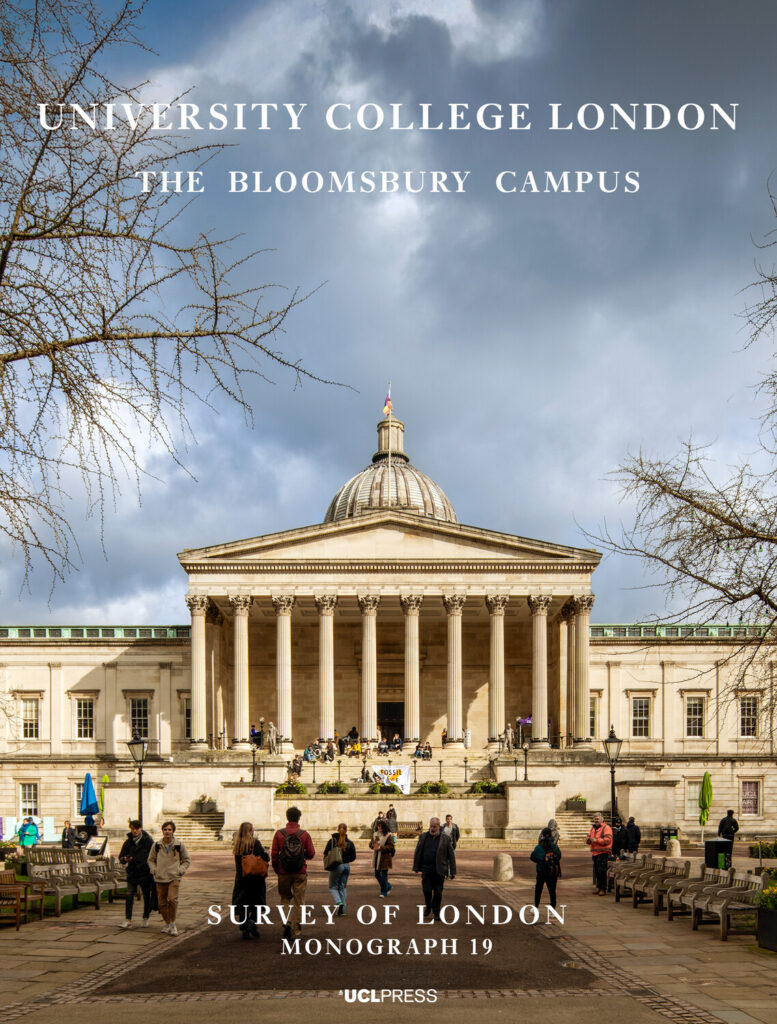
The Bloomsbury Campus
Amy Spencer (Editor), Colin Thom (Editor)
Series: Survey of London
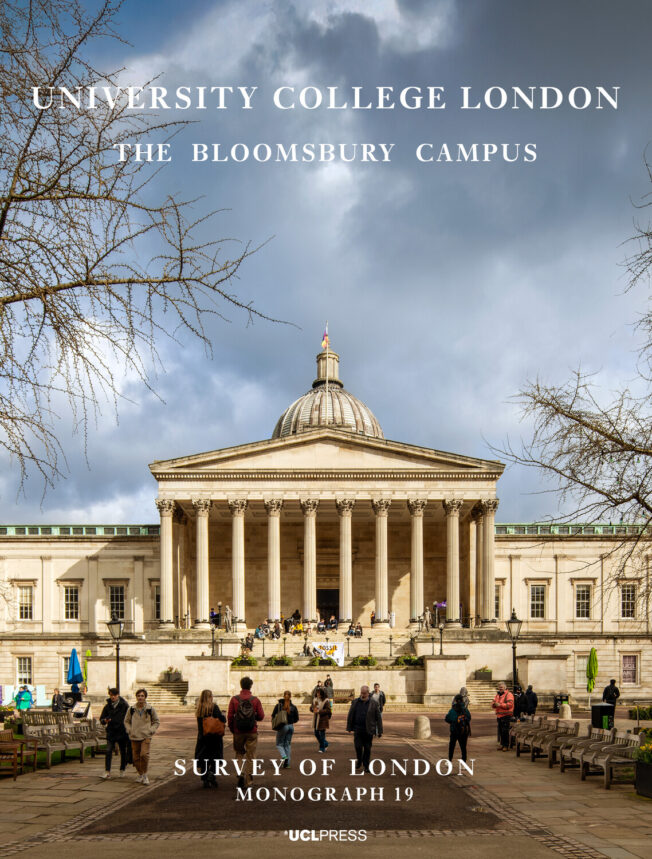
The first university in London, and the first in England to accept people of all faiths and creeds, University College London occupies a prestigious position in the history of British education. Since its foundation in 1826 and the construction shortly afterwards of its iconic neoclassical building in Gower Street, UCL has been an increasingly influential presence in the capital’s Bloomsbury district, shaping the character of its built environment and acting as a magnet for other academic institutions. Over two hundred years UCL has expanded to form an extensive campus, its sprawling footprint and varied building stock reflecting growth in student numbers and advances in education, technology and culture.
Having been part of UCL’s Bartlett School of Architecture since 2013, the Survey of London is uniquely placed to offer the first comprehensive account of the university’s buildings and the evolution of its historic Bloomsbury campus. This monograph, published in 2026 to coincide with the bicentenary of UCL’s foundation, provides a new understanding of this significant estate in central London, bringing to light a complex and engaging architectural story with many facets that have been previously overlooked or neglected. It charts a progression in UCL’s architecture from the Greek Revival classicism of the early nineteenth century, through Victorian experimentation and inter-war Neo-Georgian, to post-war Brutalism and today to the high-tech, energy efficient and adaptable buildings expected of a modern university.
Based on original documentary research and site investigation, and generously illustrated with more than 270 photographs, maps and drawings, many of them specially commissioned, the Survey’s monograph provides a valuable record and analysis of UCL’s Bloomsbury campus for the future.
List of Illustrations
Introduction
1 The Wilkins Building
2 The Main Quadrangle
3 The South Quadrangle
4 Gower Street
5 Gower Place
6 Malet Place and Foster Court Area
7 Gordon Street and Gordon Square
8 Tavistock Square Area
9 Bedford Way and Woburn Square
10 The Cruciform Building
11 Medical Buildings West of Gower Street
12 Tottenham Court Road Area
References and List of Abbreviations
Index
Number of illustrations: 275
Publication date: 11 February 2026
PDF ISBN: 9781806550784
EPUB ISBN: 9781806550791
Hardback ISBN: 9781806550760
Paperback ISBN: 9781806550777
Amy Spencer (Editor)
Amy Spencer is an architectural historian and Research Fellow at the Bartlett School of Architecture, who has been contributing to the Survey of London series of volumes for the past ten years, including those on Oxford Street (2020) and Whitechapel (2022). A graduate of Durham University and the Courtauld Institute of Art, since joining the Survey she has developed a specialism in studying institutional buildings and their often complex urban sites. The knowledge that Amy gained from her Bartlett doctorate on the pre-war history of UCL’s Bloomsbury campus (completed in 2021) is the driving force behind the Survey of London’s new monograph.
Colin Thom (Editor)
Colin Thom is Director of the Survey of London, where for many years now he has contributed to the research, writing, editing and production of the Survey’s renowned series of volumes on London’s history and architecture. He edited the landmark 50th volume, Battersea: Houses and Housing (2013) and co-edited the two-volume set on South-East Marylebone, (2017), which was awarded the Society of Architectural Historians of Great Britain’s prestigious Colvin Prize for 2018 as the leading work of reference on an architectural subject. An MA Honours graduate of Glasgow University, Colin worked in the photo and film archive of London Transport Museum before joining the Survey. As well as his main interest in London’s built environment, Colin is also an expert on the eighteenth-century architect Robert Adam. He edited a collection of new research on Adam, Robert Adam and his Brothers (2019), and is currently working on a new edition of Adam’s Grand Tour correspondence.
‘a magnificent new architectural history of UCL’s Bloomsbury campus’
Daily Telegraph
Related titles
London’s Urban Landscape
Professor Christopher Tilley, Professor of Anthropology & Archaeology, UCL,
07 May 2019
University College London
The Bloomsbury Campus
Series: Survey of London
Publication date: February 11, 2026
Open Access PDF ISBN: 9781806550784
Paperback ISBN: 9781806550777
Hardback ISBN: 9781806550760
Trim size (hardback): 28.6cm x 21.3cm
Trim size (paperback): 28.6cm x 21.3cm
The first university in London, and the first in England to accept people of all faiths and creeds, University College London occupies a prestigious position in the history of British education. Since its foundation in 1826 and the construction shortly afterwards of its iconic neoclassical building in Gower Street, UCL has been an increasingly influential presence in the capital’s Bloomsbury district, shaping the character of its built environment and acting as a magnet for other academic institutions. Over two hundred years UCL has expanded to form an extensive campus, its sprawling footprint and varied building stock reflecting growth in student numbers and advances in education, technology and culture.
Having been part of UCL’s Bartlett School of Architecture since 2013, the Survey of London is uniquely placed to offer the first comprehensive account of the university’s buildings and the evolution of its historic Bloomsbury campus. This monograph, published in 2026 to coincide with the bicentenary of UCL’s foundation, provides a new understanding of this significant estate in central London, bringing to light a complex and engaging architectural story with many facets that have been previously overlooked or neglected. It charts a progression in UCL’s architecture from the Greek Revival classicism of the early nineteenth century, through Victorian experimentation and inter-war Neo-Georgian, to post-war Brutalism and today to the high-tech, energy efficient and adaptable buildings expected of a modern university.
Based on original documentary research and site investigation, and generously illustrated with more than 270 photographs, maps and drawings, many of them specially commissioned, the Survey’s monograph provides a valuable record and analysis of UCL’s Bloomsbury campus for the future.
‘a magnificent new architectural history of UCL’s Bloomsbury campus’
Daily Telegraph