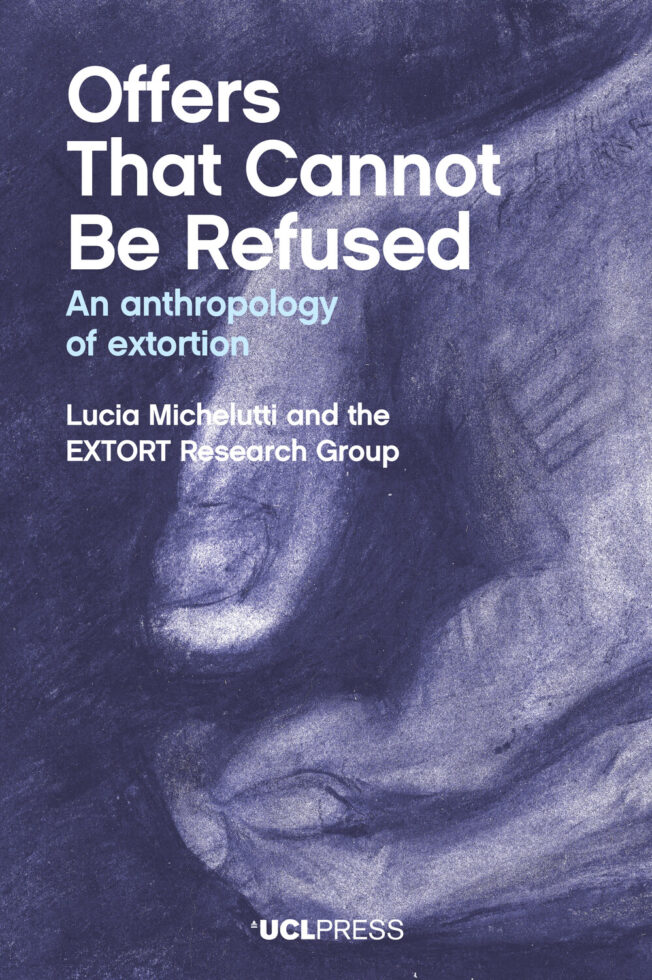

Offers That Cannot Be Refused
An anthropology of extortion
Lucia Michelutti (Author), EXTORT Research Group (Author)
Departing from exclusively legalistic definitions of racket-like exchanges, this book sets up extortion as an ethnographic object: as ‘offers that cannot be refused’. Combining original ethnography with compelling storytelling, it traces the social life of unrefusable offers across Bangladesh, Bolivia, Brazil, China, Ecuador, Guatemala, India, Italy, Nigeria, Pakistan, Peru, South Africa, Sri Lanka and the United Kingdom.
This anthropological analysis is grounded in collaborative and comparative ethnography conducted by a team of 18 anthropologists. The result is a gripping story that explores the ordinariness of extortion beyond conventional organized crime and mafias domains. The book shows how the strength of extortion social logics lies in the gradual and complicit inclusion of individuals and populations within relationships that are both attractive and violent. Taking by threatening while pretending to give something in return appears to be a crucial dimension of contemporary society from Oval Office to petrol stations, from the floors of the IMF to lawyers in provincial towns in South Asia, from the mineral-extraction activities of the Kremlin to the sandalwood smugglers of the forests of Seshachalam, extortion reverberates across various scales.
This exploration offers a fresh perspective on enduring theoretical question, including the nature of law and the economy, as well as the dynamics of intimate violence, consent and capitalist accumulation in the contemporary world.
Contents
List of authors
Introduction
Extortion Ordinariness
1 Three Stories of Extortion from Kolkata
“If you do not let us handle the work, you will lose your land.”
Arild Engelsen Ruud
2 Stories of Extortion in Everyday Business Relations in Bolivia: When the Extorted Becomes the Extorter
“If you don’t lower my rent, I’ll report you to the tax office and they will fine you for your untaxed income.”
Miranda Sheild Johansson
3 Stories of Sexualized Extortion in North India
“If you do not give me Rs5,000,000, I accuse you of rape.”
Lucia Michelutti
4 A Shared Accusation: Everyday Extortion and Debt in an Amazonian Quilombo Area
“If you do not accept these terms, you will be left with nothing.”
Julia F. Sauma
5 Stories of Extortion in the Construction Mafia in Cape Town and Durban
“This is our land!”
Brandaan Huigen
6 Stories of Extortion in Sandalwood Smuggling in South India
“If you don’t give me Rs70,000, I will not give you bail and you will spend in jail ten years waiting for trial.”
David Picherit
7 Stories of Extortion Through Time in Guatemala City: From Rupture to Resignation in a Gang Extortion Zone
“If you do not pay what the gang demands, we will kill you or force you to flee.”
Katherine Saunders-Hastings
8 Stories of Extortion and Patronage in Rural Punjab
“Vote for me and pay your share or face the police without a shield.”
Nicolas Martin
9 The Rise of Digital Microloan Apps: Stories of Extortion in Nigeria
“Your aspirations are within reach, but so is your downfall if you default.”
Davide Casciano
10 Stories of Extortions and Petrol Station Dreams
“If you don’t take the offer on the table (the contract,) you won’t be able to help your friends and family fleeing the war.”
Yathukulan Yogarajah
11 The War for Legal Markets: Stories of Extortion in Bolivian Informal Economies
“Do not sell what we sell, or the police will seize your goods.”
Fernando Rabossi and Nico Tassi
12 Stories of Extortion Among Pakistani Migrants in Italy
“If you do not work for free, I will divorce your sister.”
Tommaso Sbriccoli
13 Stories of Extortion Between Chinese Miners and Shuar Communities in Ecuador
“We will buy you a car if…”
Liliana Arias, Hans Caycedo and Hans Steinmüller
14 Stories of Extortion in Pakistan: Blood Money and Forgiveness in Murder Cases
“If you do not forgive me in court for having murdered your relative, I will have my men rain bullets on your house.”
Paul Rollier
15 Stories of Extortion in the Bolivian Cocaine Trade
“If you do not pay your debts, we will kidnap your kids.”
Thomas Grisaffi
16 Stories of Extortion In and In-Between Britain and Bangladesh
“If you want peace, stop doing politics”
Ashraf Hoque
Conclusion
An Anthropology of Extortion
DOI: 10.14324/111.9781806551071
Publication date: 06 July 2026
PDF ISBN: 9781806551071
EPUB ISBN: 9781806551088
Hardback ISBN: 9781806551057
Paperback ISBN: 9781806551064
Lucia Michelutti (Author)
Lucia Michelutti is Professor of Anthropology at University College London (UCL). Her research expertise spans from political and legal anthropology to the ethnographic study of informal economies as well as the anthropology of caste, kingship and ritual. She has carried out extensive fieldwork in North India and has worked in Venezuela and on South Asia and Latin America in comparative contexts. She is currently the Principal Investigator of the project ‘Anthropologies of Extortion’ (2021-2026) funded by the European Research Council.
EXTORT Research Group (Author)
The EXTORT Research Group consists of 18 investigators: Liliana Arias, Davide Casciano, Hans Caycedo, Brandaan Huigen, Fernando Rabossi, Thomas Grisaffi, Ashraf Hoque, Miranda Sheild Johansson, Nicolas Martin, David Picherit, Paul Rollier, Aril Engelsen Ruud, Julia Sauma, Kate Saunders-Hastings, Tommaso Sbriccoli, Hans Steinmüller, Nico Tassi, and Yathukulan Yogarajah.
Related titles
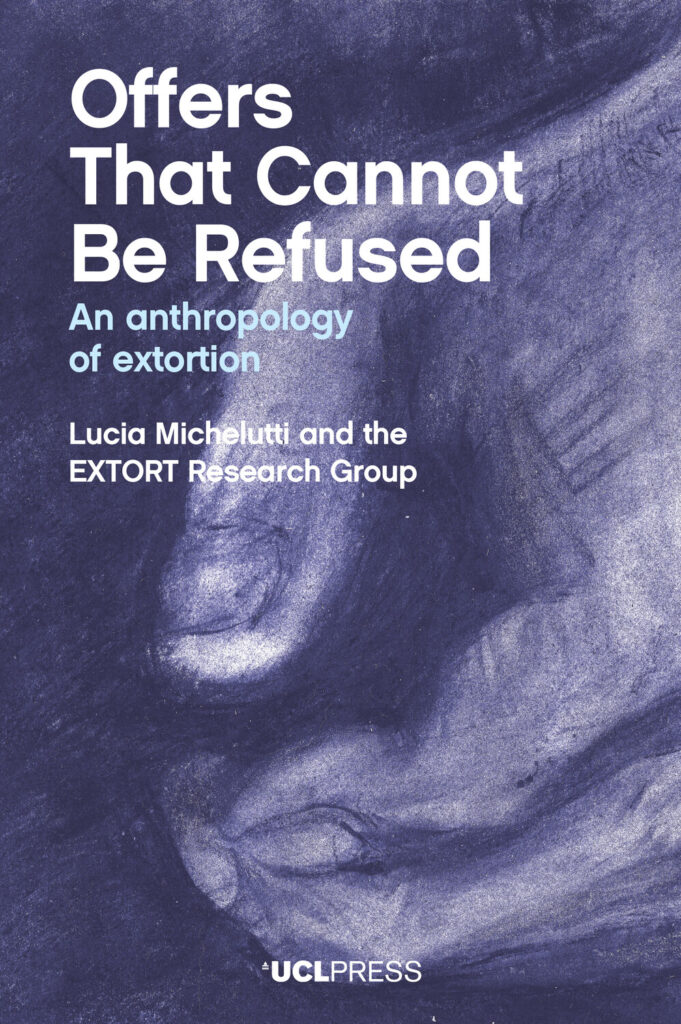
Offers That Cannot Be Refused
An anthropology of extortion
Publication date: July 6, 2026
Open Access PDF ISBN: 9781806551071
Paperback ISBN: 9781806551064
Hardback ISBN: 9781806551057
Trim size (hardback): 23.4cm x 15.6cm
Trim size (paperback): 23.4cm x 15.6cm

Departing from exclusively legalistic definitions of racket-like exchanges, this book sets up extortion as an ethnographic object: as ‘offers that cannot be refused’. Combining original ethnography with compelling storytelling, it traces the social life of unrefusable offers across Bangladesh, Bolivia, Brazil, China, Ecuador, Guatemala, India, Italy, Nigeria, Pakistan, Peru, South Africa, Sri Lanka and the United Kingdom.
This anthropological analysis is grounded in collaborative and comparative ethnography conducted by a team of 18 anthropologists. The result is a gripping story that explores the ordinariness of extortion beyond conventional organized crime and mafias domains. The book shows how the strength of extortion social logics lies in the gradual and complicit inclusion of individuals and populations within relationships that are both attractive and violent. Taking by threatening while pretending to give something in return appears to be a crucial dimension of contemporary society from Oval Office to petrol stations, from the floors of the IMF to lawyers in provincial towns in South Asia, from the mineral-extraction activities of the Kremlin to the sandalwood smugglers of the forests of Seshachalam, extortion reverberates across various scales.
This exploration offers a fresh perspective on enduring theoretical question, including the nature of law and the economy, as well as the dynamics of intimate violence, consent and capitalist accumulation in the contemporary world.