
Publication date: 22 July 2026
DOI: https://doi.org/10.14324/111.9781806551156
Number of illustrations: 8

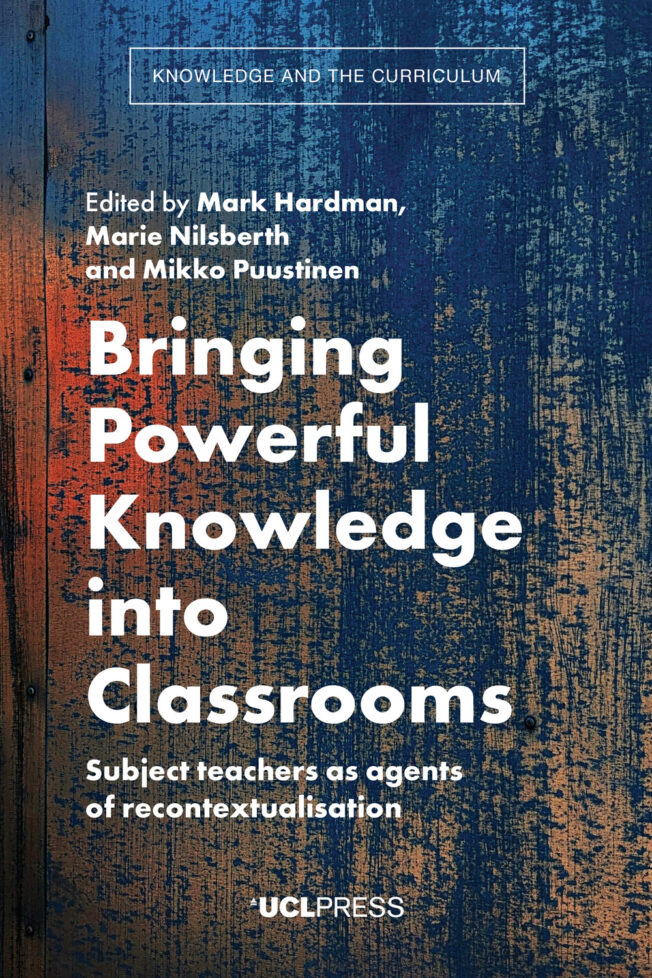
Bringing Powerful Knowledge into Classrooms
Subject teachers as agents of recontextualisation
Mark Hardman (Editor), Marie Nilsberth (Editor), Mikko Puustinen (Editor)
Series: Knowledge and the Curriculum
Powerful knowledge equips students with the capacity to engage with systematic, disciplinary thinking, to imagine futures that are not yet conceived and think what is yet to be thought. Bringing Powerful Knowledge into Classrooms explores how teachers develop such knowledge in classrooms by transforming disciplinary understandings through subject teaching that responds to the educational needs of society.
Drawing on Bernstein’s concept of recontextualisation and theories of teacher agency, the book examines how teachers navigate the boundaries between academic disciplines, school subjects and everyday knowledge. Through empirical case studies from England, Finland and Sweden, it illustrates how teachers’ decisions are shaped by national expectations, institutional frameworks and classroom dynamics. Combining Anglophone and Nordic traditions in subject teaching with curriculum theory and classroom research, the book offers a theoretically grounded yet practical account of how teachers recontextualise knowledge. It develops new insights into teacher agency and recontextualisation which are highly relevant to teacher education, curriculum design and educational policy. By focusing on real-life teaching across a range of subjects, the book deepens our understanding of how powerful knowledge is brought into classrooms and how teachers can be supported in this vital work.
List of figures
List of tables
Notes on contributors
Introduction
Part I: Key theories and concepts
1 Powerful knowledge as a point of departure
Amna Khawaja, Marie Nilsberth, Mikko Puustinen
2 Disciplines and school subjects
Alison Kitson, Jenni Marjokorpi and Martin Stolare
3 Teacher agency and teacher knowledge
Mark Hardman, Alison Kitson, Mikko Puustinen
4 Multinational contexts for recontextualisation
Martin Stolare, Mikko Puustinen, Amna Khawaja, Mark Hardman
Part II: Empirical examples: powerful knowledge in teaching
5 Reaching vertical discourses through classroom interaction
Jenni Marjokorpi and Liisa Tainio
6 Digitally mediated transformations and teacher beliefs in teaching literary reading
Marie Nilsberth and Christina Olin-Scheller
7 The materiality of classrooms
John-Paul Riordan and Mark Hardman
8 Understanding and unpacking societal pressure that influences recontextualisation – the case of history
Mikko Puustinen and Amna Khawaja
9 Agency and recontextualisation in the physics classroom
Alison Kitson
10 Recontextualising geography for the classroom
Alex Standish
Part III: Insights and developments
11 Aiming for powerful knowledge: curriculum futures across empirical cases
Amna Khawaja and Mikko Puustinen
12 Theorising the recontextualisation processes: the teacher’s role revisited
Mikko Puustinen, Jenni Marjokorpi, Amna Khawaja
13 Teacher agency within recontextualisation events
Mark Hardman, Alison Kitson, Mikko Puustinen
14 Bringing powerful knowledge into classrooms: subject teachers as agents of recontextualisation
Marie Nilsberth, Mark Hardman and Mikko Puustinen
Index
DOI: 10.14324/111.9781806551156
Number of illustrations: 8
Publication date: 22 July 2026
PDF ISBN: 9781806551156
EPUB ISBN: 9781806551163
Hardback ISBN: 9781806551132
Paperback ISBN: 9781806551149
Mark Hardman (Editor) 
Mark Hardman is associate professor in the Centre for Teachers and Teaching Research, at UCL’s Institute of Education. He has been a science teacher educator for two decades, and his teaching and research both focus on supporting teachers to become agents of change: within the lives of young people, communities, and the world more broadly.
Marie Nilsberth (Editor)
Marie Nilsberth is professor in Educational Work at Karlstad University, Sweden. Her research concerns teaching and learning with an interest in classroom interaction, particularly in relation to ongoing digitalisation and platformisation of education. In several studies she explores literacy practices from subject didactic perspectives, and investigates how digitalisation changes terms for participation and inclusion from epistemic as well as social perspectives. Nilsberth has professional experience as middle school teacher, and is currently vice chair of the teacher education at Karlstad University.
Mikko Puustinen (Editor)
Mikko Puustinen, PhD, is associate professor at university of Helsinki. He is societally oriented educationalist with a background in the discipline of history. Puustinen has studied Finnish teacher education, disciplinary knowledge in subject-specific teaching, the rhetoric of public debate on education, and discussion culture in universities. He is particularly interested in knowledge, the interaction between education and society, and the recontextualisation of curriculum knowledge. His ongoing research projects focus on envisaging sustainable futures via powerful knowledge and difficult topics and dialogue in education.
Related titles
Bringing Powerful Knowledge into Classrooms
Subject teachers as agents of recontextualisation
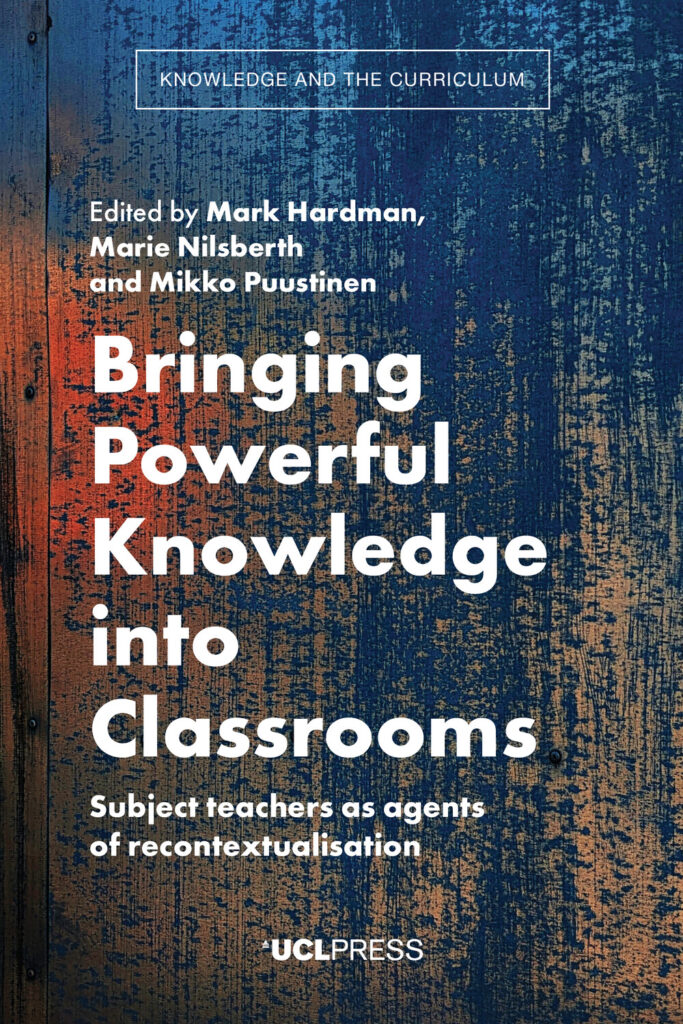
Series: Knowledge and the Curriculum
Publication date: July 22, 2026
Open Access PDF ISBN: 9781806551156
Paperback ISBN: 9781806551149
Hardback ISBN: 9781806551132
Trim size (hardback): 23.4cm x 15.6cm
Trim size (paperback): 23.4cm x 15.6cm
Powerful knowledge equips students with the capacity to engage with systematic, disciplinary thinking, to imagine futures that are not yet conceived and think what is yet to be thought. Bringing Powerful Knowledge into Classrooms explores how teachers develop such knowledge in classrooms by transforming disciplinary understandings through subject teaching that responds to the educational needs of society.
Drawing on Bernstein’s concept of recontextualisation and theories of teacher agency, the book examines how teachers navigate the boundaries between academic disciplines, school subjects and everyday knowledge. Through empirical case studies from England, Finland and Sweden, it illustrates how teachers’ decisions are shaped by national expectations, institutional frameworks and classroom dynamics. Combining Anglophone and Nordic traditions in subject teaching with curriculum theory and classroom research, the book offers a theoretically grounded yet practical account of how teachers recontextualise knowledge. It develops new insights into teacher agency and recontextualisation which are highly relevant to teacher education, curriculum design and educational policy. By focusing on real-life teaching across a range of subjects, the book deepens our understanding of how powerful knowledge is brought into classrooms and how teachers can be supported in this vital work.