Bringing Powerful Knowledge into Classrooms

Powerful knowledge equips students with the capacity to engage with systematic, disciplinary thinking, to imagine futures that are not yet conceived and think what is yet to be thought. Bringing Powerful Knowledge into Classrooms explores how teachers develop such knowledge in classrooms by transforming disciplinary understandings through subject teaching that responds to the educational needs of society.

Drawing on Bernstein’s concept of recontextualisation and theories of teacher agency, the book examines how teachers navigate the boundaries between academic disciplines, school subjects and everyday knowledge. Through empirical case studies from England, Finland and Sweden, it illustrates how teachers’ decisions are shaped by national expectations, institutional frameworks and classroom dynamics. Combining Anglophone and Nordic traditions in subject teaching with curriculum theory and classroom research, the book offers a theoretically grounded yet practical account of how teachers recontextualise knowledge. It develops new insights into teacher agency and recontextualisation which are highly relevant to teacher education, curriculum design and educational policy. By focusing on real-life teaching across a range of subjects, the book deepens our understanding of how powerful knowledge is brought into classrooms and how teachers can be supported in this vital work.
On Learning, Volume 3

This book, as you can see from its title, is about learning, or at least about the concept and practice of learning. It investigates two meta-concepts, knowledge and learning, the relationship between the two, and the way these can be framed in epistemic, social, political and economic terms. Knowledge and learning, as meta-concepts, are positioned in various networks of meaning, principally the antecedents of the concepts, their relations to other relevant concepts, and the way the concepts are used in the lifeworld. This book explores a number of important concepts that are relevant to the idea of learning. These are meta-concepts such as epistemology, semantics, phenomenology, rationality, thinking, hermeneutics, critical realism and pragmatism, and meso-concepts such as a Bildung, justification, mathematical concepts such as averaging, probability, comparison, prediction and correlation, a bureaucratic theory of learning, social categories of learning and knowledge, and the relationship between ethics and learning.

On Learning, Volume 3: Knowledge, curriculum and ethics, like the first two volumes, is a response to empiricist and positivist conceptions of knowledge. The author challenges detheorised and reductionist ideas of learning that have filtered through to the management of our schools, colleges and universities, over-simplified messages about learning, knowledge, curriculum and assessment, and the denial that values are central to understanding how we live and how we should live.

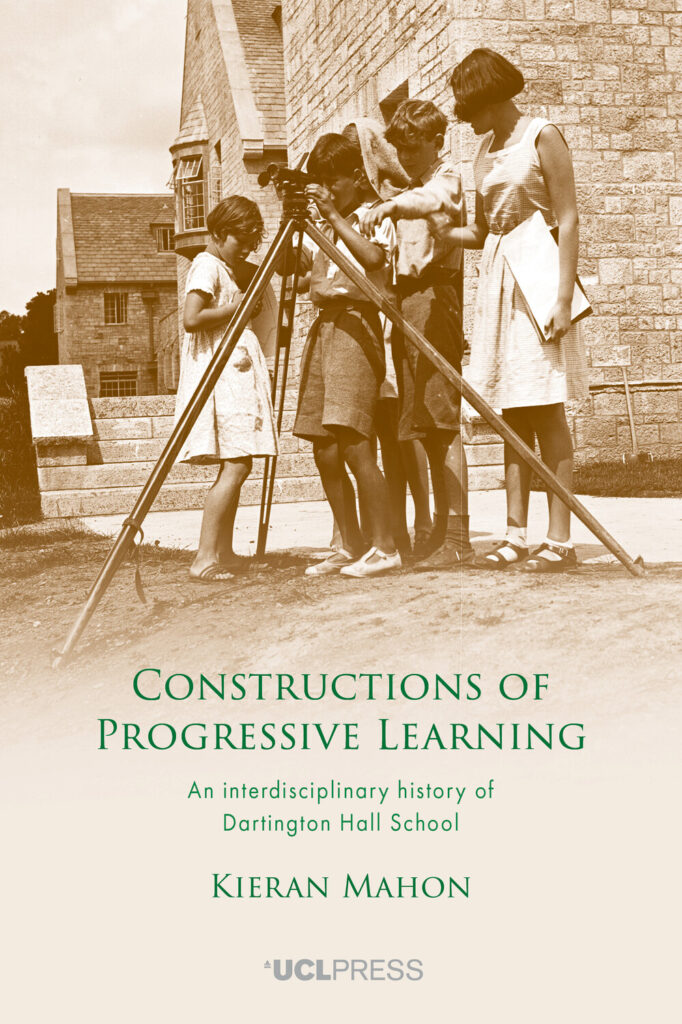
Constructions of Progressive Learning

Dartington Hall School in Devon, England (1926–87) was one of the most celebrated showpieces of progressive education. Founded within a wider project of social and rural reconstruction, it gained international attention for its commitment to freedom, creativity and child centred learning. Eminent thinkers including Bertrand Russell and Aldous Huxley sent their children to Dartington, while visitors travelled from near and far to observe its distinctive ethos. In its early decades, the school developed some of the most specialised educational architecture in the country, collaborating with notable architects such as Oswald P. Milne and William Lescaze.

Constructions of Progressive Learning tells the story of the institution through its architecture – a perspective largely overlooked in histories of progressive education. The book demonstrates how Dartington’s learning environments both shaped and reflected changing ideas about the body, gender, democracy, pedagogy and class. It argues that the architecture of progressive education was not fixed, but evolved in response to shifts in leadership, policy and educational philosophy. Drawing on Dartington’s innovations in performance writing, the book weaves archival research, oral history and site writing practices into a richly layered narrative. The method brings marginalised voices of forgotten staff and students into dialogue with more dominant accounts of headmasters and architects. In doing so, the book offers a timely reflection on how educational environments might centre wellbeing, relationships and lived experience, rather than performance metrics alone.

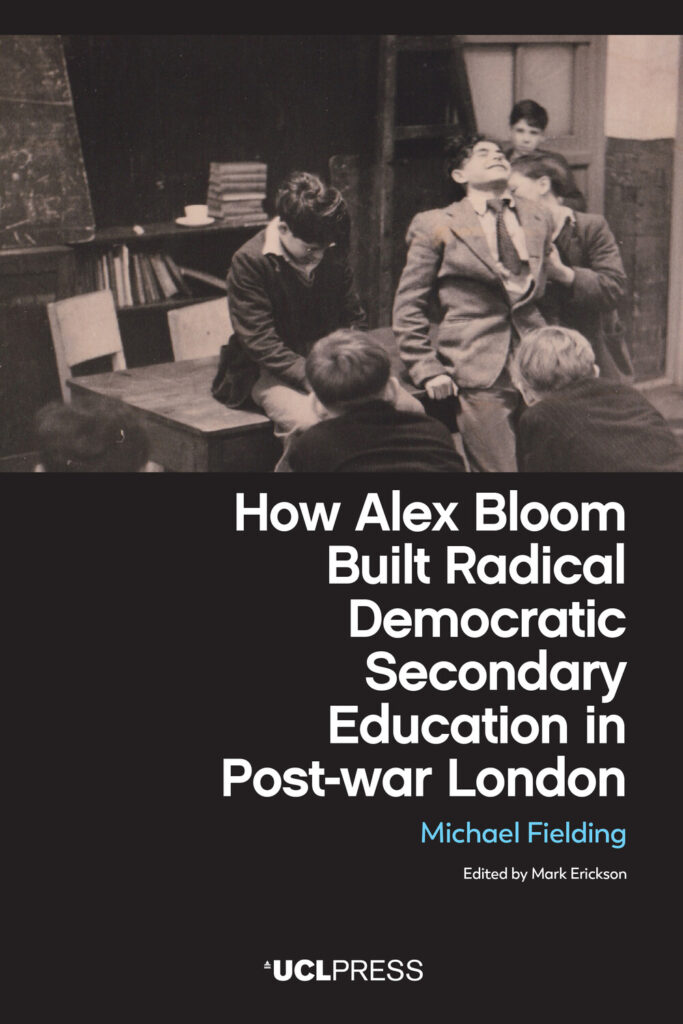
How Alex Bloom Built Radical Democratic Secondary Education in Post-war London

Alex Bloom (1895–1955) was a remarkable school leader whose reputation in his lifetime extended far beyond the UK. Against the odds, in the bomb-damaged remains of London’s East End immediately after the Second World War, he established a school that championed equality, democracy, diversity and creativity. That school – St George-in-the-East Secondary Modern in Cable Street – is known to many as the inspiration for the novel and film To Sir With Love, but its significance for education goes far deeper. An explicit affirmation of Bloom’s progressive values and aspirations, it had no punishments or rewards, no prizes or failures, and no set curriculum. It became a beacon for radical democratic schooling, achieving an astonishing international reputation and a lasting legacy.

Based on primary research with former teachers and pupils of St George-in-the-East, How Alex Bloom Built Radical Democratic Secondary Education in Post-war London recounts the story of the school’s founding, pedagogy and democratic inclusivity. Through the book’s own narrative, and in short contributions from some of today’s leading educators, it examines Bloom’s contemporary and subsequent influence on education in the UK and further afield. Most of all, this book reveals Alex Bloom’s extraordinary dedication and commitment to his staff, his pupils and their community, exemplifying the importance of engaging with the school’s contemporary realities.

Universities and Climate Action

Universities have a pivotal role to play in addressing the climate crisis, not only educating an increasingly large proportion of the global population, but also through scientific breakthroughs, technological innovation and raising public awareness. Higher education is particularly important given the roots of ecological and social breakdown in our models of civilisation, culture and knowledge. Yet its potential has not always been realised, and universities have historically been implicated in the exploitation and destruction of the natural environment and human communities. A transformation is thus needed in higher education, with institutions reorienting their activities towards positive engagement with climate.

Universities and Climate Action presents an original framework for understanding the impact of universities on climate change. It explores the interactions of education, research, services, public debate and campus operations on society and the ecosphere, and the complex interplay of influences on local, national and global levels. It provides in-depth discussions of ways of engaging with climate in teaching and learning and the curriculum, in research agendas, in governance and management of estates, and in engaging with external communities. The theoretical models are contextualised with examples of climate action in universities around the world. This book provides vital tools for analysis and action for researchers and practitioners working with and within the higher education sector.

On Learning, Volume 2

This edited book, as you can see from its title, is about learning, or at least about the concept and practice of learning. The contributors to this volume are focusing on two meta-concepts, knowledge and learning, on the relationship between the two, and the way these can be framed in epistemic, social, political and economic terms. Knowledge and learning, as meta-concepts, are positioned in various networks or constellations of meaning, principally: the antecedents of the concepts, their relations to other relevant concepts, and the way the concepts are used in the lifeworld.

In this book the various authors explore a number of important concepts that are relevant to the idea of learning. These are meta-concepts such as epistemology, inferential role semantics, phenomenology, rationality, thinking, hermeneutics, critical realism and pragmatism, and meso-concepts such as probability, woman, training, assessment, education, system, race, friendship, Bildung, curriculum, ecology and pedagogy. Like David Scott’s first volume of On Learning, this collection focusing on philosophy, concepts and practices is a response to empiricist and positivist conceptions of knowledge. It challenges detheorised and reductionist ideas of learning that have filtered through to the management of our schools, colleges and universities; over-simplified messages about learning, knowledge, curriculum and assessment; and fostered the denial that values are central to understanding how we live and how we should live – the normative dimension to social policy and social theorising. This book is also an attempt at a Bildungstheorie.

On Learning

This is a philosophical work that develops a general theory of ontological objects and object-relations. It does this by examining concepts as acquired dispositions, and then focuses on perhaps the most important of these: the concept of learning. This concept is important because everything that we know and do in the world is predicated on a prior act of learning.

A concept can have many meanings and can be used in a number of different ways, and this creates difficulty when considering the nature of objects and the relationships between them. To enable this, David Scott answers a series of questions about concepts in general and the concept of learning in particular. Some of these questions are: What is learning? What different meanings can be given to the notion of learning? How does the concept of learning relate to other concepts, such as innatism, development and progression?

The book offers a counter-argument to empiricist conceptions of learning, to the propagation of simple messages about learning, knowledge, curriculum and assessment, and to the denial that values are central to understanding how we live. It argues that values permeate everything: our descriptions of the world, the attempts we make at creating better futures and our relations with other people.

Praise for On Learning

‘Provides a nuanced and layered understanding of the complex concept and practice of learning to students and researchers.’
Educational Review

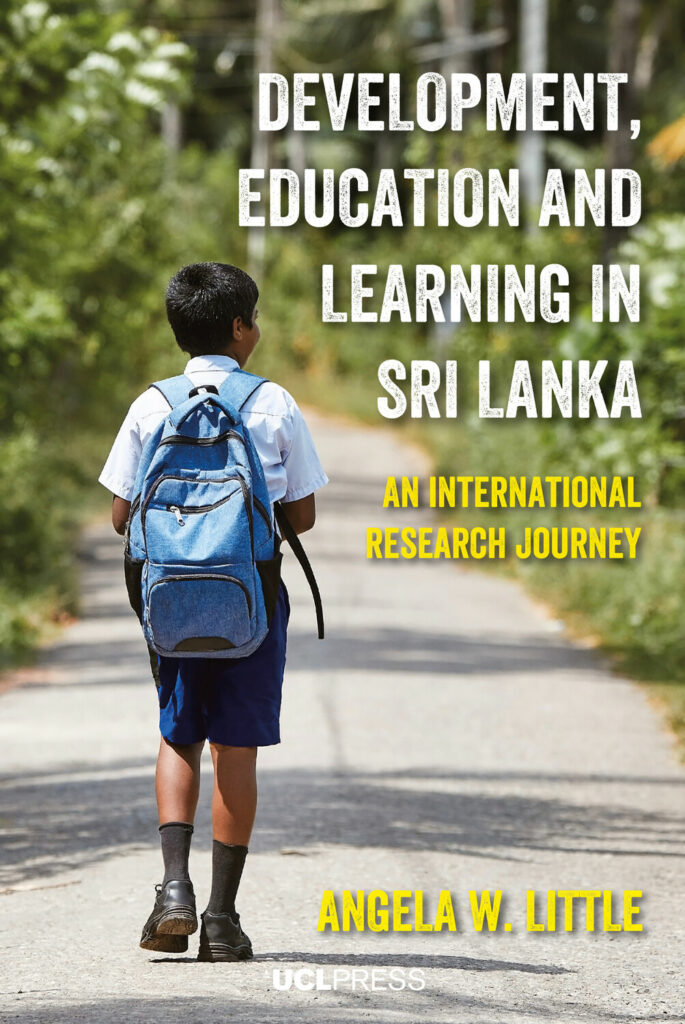
Development, Education and Learning in Sri Lanka

Sri Lanka’s early achievements in education and literacy became well known among the international development community in the middle of the last century and were often used to benchmark progress elsewhere. Development, Education and Learning in Sri Lanka presents an illuminating narrative of changing education fortunes and inequalities, based on half a century of research. This research journey was undertaken in collaboration with Sri Lankan researchers island-wide in myriad communities, schools, classrooms and education offices, through conversations with countless parents, teachers, students, community members, trade union officers, politicians and members of local, national and international development agencies, as well as through extensive documentary analysis.

The book delineates the distinctive and changing features of the Sri Lankan education system through comparisons with systems elsewhere, through an understanding of national political, economic and social conditions, crises and upheavals, through changes in education policy and through shifting patterns of opportunity among diverse social groups. These analyses are framed by themes in the international development discourse ranging from modernisation to basic needs to globalisation and sustainable development, some of which themes have been influenced by the Sri Lankan story. The book’s overriding messages are the need to understand education and development in a country’s own terms, and to place learning at the heart of education policy, situating it within broader conceptions of the purpose, values and means of development.

Sign up to our newsletter

Don't miss out!
Subscribe to the UCL Press newsletter for the latest open access books,
journal CfPs, news and views from our authors and much more!