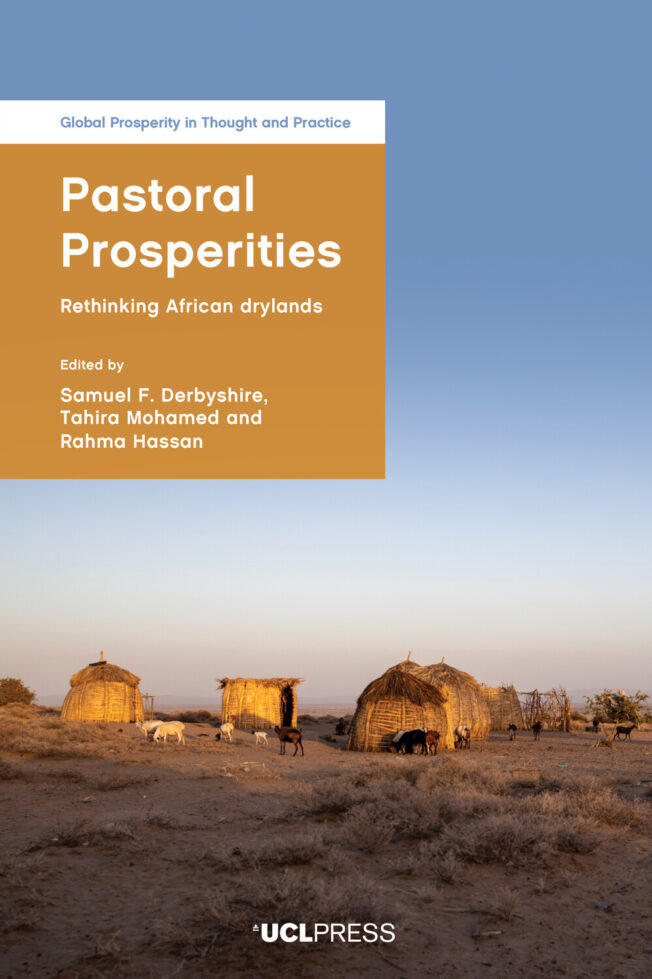
Pastoral Prosperities
Rethinking African drylands
Samuel F. Derbyshire (Editor), Tahira Mohamed (Editor), Rahma Hassan (Editor)
Pastoral Prosperities brings together contributions from diverse disciplinary perspectives to explore the intersecting themes shaping the future of mobile pastoralism in Africa’s drylands. Offering rich empirical material, it builds on recent pioneering works that have rethought fundamental assumptions about prosperity and development, questioning visions and rationalities that have hitherto been oriented towards maximising market growth rather than fostering well-being, quality of life and planetary health. The book asks what other ways of imagining social and environmental futures emerge in the drylands, alongside or beyond the narrow frame of GDP-based indicators.
Taking stock of the enduring power of restrictive narratives about pastoralism’s past and future, the volume considers the counter-narratives of prosperity that gain traction amidst the heterogeneous and complex drylands of today. It explores the aspirations, practices and struggles that must be understood to make sense of ongoing processes of radical socio-economic, political and environmental change. In doing so, Pastoral Prosperities highlights both the shortcomings of implicit assumptions prevalent across various key sectors and the scope for new cross-disciplinary and cross-sectoral conversations that might inform more grounded approaches to investment, governance and humanitarian action.
List of figures
List of tables
List of contributors
List of abbreviations
Foreword
Acknowledgements
Introduction: Pastoral prosperities
Samuel F. Derbyshire, Tahira Mohamed and Rahma Hassan
Part I: Crisis
1 Pastoral prosperity in crisis
Samuel F. Derbyshire and Rahma Hassan
2 Projections of prosperity: crisis, development and the marginalisation of pastoralism in Ethiopia
Roba Jilo
3 Sharing futures: lessons from pastoralist disaster response in northern Somalia
Sahra Ahmed Koshin
4 Prosperity in decline: moral and political ecologies of pastoral adaptation in Guji and Borana, Ethiopia
Geleta Tesfaye Berisso
Part II: Commerce
5 Negotiating prosperity: pastoralist livestock marketing in northern Kenya
Guyo Roba
6 Markets, conflict and change: forging prosperity through uncertainty in pastoral Kenya and Ethiopia
Rupsha Banerjee, Tanaya DuttaGupta, Kelvin Shikuku, Meshak Baraza, Watson Lepariyo, Diba Galgalo and Wako Gobu
7 Pastoralist women’s pathways to prosperity: collective solidarity, commoning and moral economy practices in Kenya’s arid and semi-arid lands
Eunice Wangari-Muneri and Tahira Mohamed
Part III: Connection
8 Social capital and everyday practices of resilience building among pastoralists in Karamoja
Padmini Iyer and Simon Peter Longoli
9 Nomadic skillsets beyond the desert: Western Sahara’s post-pastoralist generation
Matthew Porges
10 Navigating uncertainty through institutional adaptability in northern Uganda
Matteo Caravani
Afterword: the drylands of tomorrow
Gufu Oba
DOI: 10.14324/111.9781806552092
Number of illustrations: 29
Publication date: 01 November 2026
EPUB ISBN: 9781806552108
Samuel F. Derbyshire (Editor) 
Samuel F. Derbyshire is Regional Research Lead at the Jameel Observatory for Food Security Early Action at the International Livestock Research Institute, Nairobi, Kenya. His research explores drylands pastoralism, livelihood change, drought early warning systems and humanitarian intervention. He was previously Junior Research Fellow in Anthropology at St John’s College, University of Oxford (2018-2023). His past work has explored social and economic change in pastoralist contexts in northern Kenya, including in his book Remembering Turkana: Material Histories and Contemporary Livelihoods in North-Western Kenya (Routledge, 2020).
Tahira Mohamed (Editor)
Tahira Mohamed is Regional Partnership and Engagement Lead at the Jameel Observatory for Food Security Early Action at the International Livestock Research Institute, Nairobi, Kenya. Her research examines resilience-building programs and humanitarian support in response to crises in the Horn of Africa. She holds a PhD from the University of Sussex, which she undertook via the PASTRES program. She has roughly 10 years of research experience in pastoralism, climate change, livelihood transformation, photo-voice research methods and migration.
Rahma Hassan (Editor)
Rahma Hassan is a researcher with the Centre for Research and Development in Drylands and holds a PhD in Development Studies from the University of Copenhagen and the University of Nairobi. She has worked extensively with the Feinstein International Centre and the Centre for Research and Development in the Drylands (CRDD) on pastoralist livelihoods and resilience. She has published on communal land rights and has contributed to examinations of natural governance and gender issues at the Institute for Development Studies, University of Nairobi.
Related titles
Pastoral Prosperities
Rethinking African drylands
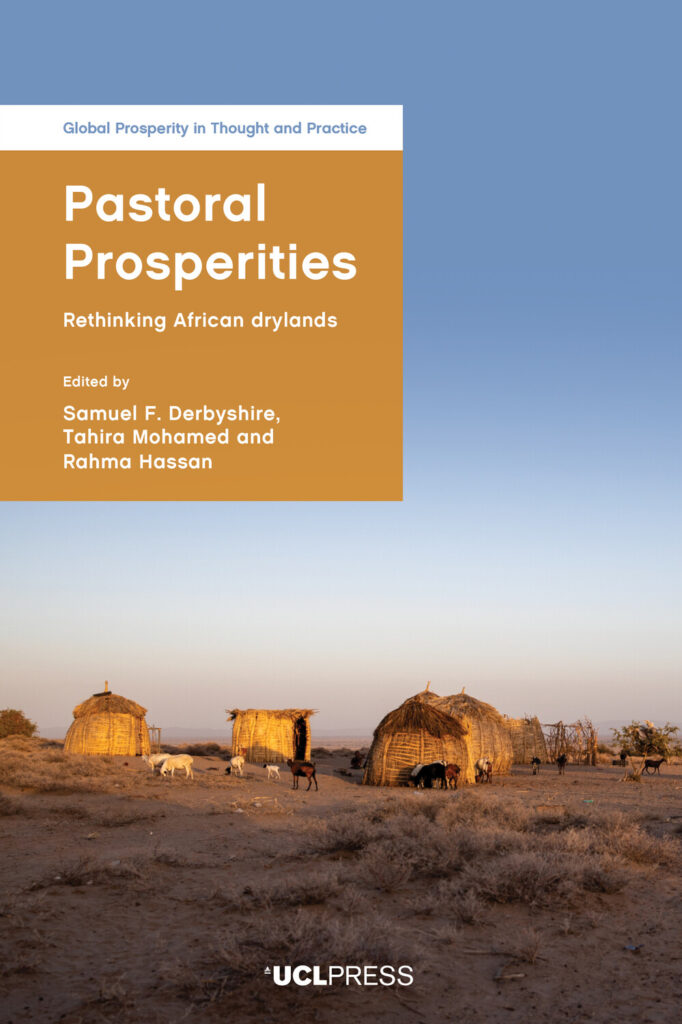
Pastoral Prosperities brings together contributions from diverse disciplinary perspectives to explore the intersecting themes shaping the future of mobile pastoralism in Africa’s drylands. Offering rich empirical material, it builds on recent pioneering works that have rethought fundamental assumptions about prosperity and development, questioning visions and rationalities that have hitherto been oriented towards maximising market growth rather than fostering well-being, quality of life and planetary health. The book asks what other ways of imagining social and environmental futures emerge in the drylands, alongside or beyond the narrow frame of GDP-based indicators.
Taking stock of the enduring power of restrictive narratives about pastoralism’s past and future, the volume considers the counter-narratives of prosperity that gain traction amidst the heterogeneous and complex drylands of today. It explores the aspirations, practices and struggles that must be understood to make sense of ongoing processes of radical socio-economic, political and environmental change. In doing so, Pastoral Prosperities highlights both the shortcomings of implicit assumptions prevalent across various key sectors and the scope for new cross-disciplinary and cross-sectoral conversations that might inform more grounded approaches to investment, governance and humanitarian action.